Lesson 1 (60′)
Engage/Warm-up (5–7′) – age-appropriate hook
Write on the board:
This weekend, I’m going to…
Students complete the sentence with one idea.
Then ask:
- Are you going to stay at home or go out?
- Are you going to rest or be active?
- Are you going to do something healthy?
Teacher says:
“Think about your real weekend. Just one or two simple plans.”
Presentation (10–12′) – micro-board notes + 6–8 model sentences
Board:
- I am going to + verb
- He / She is going to + verb
- We / They are going to + verb
Use:
- future plans
- intentions
- things decided before now
Model sentences:
- I’m going to walk after work.
- She’s going to drink more water.
- We’re going to take a short break on Saturday.
- He’s going to cook healthy meals this week.
- They’re going to visit a quiet town.
- I’m not going to work on Sunday.
- Are you going to rest this weekend?
- Is Marta going to join the class?
Quick form:
- Positive: I’m going to rest.
- Negative: I’m not going to drive.
- Question: Are you going to cook tonight?
New Week, Better Plan
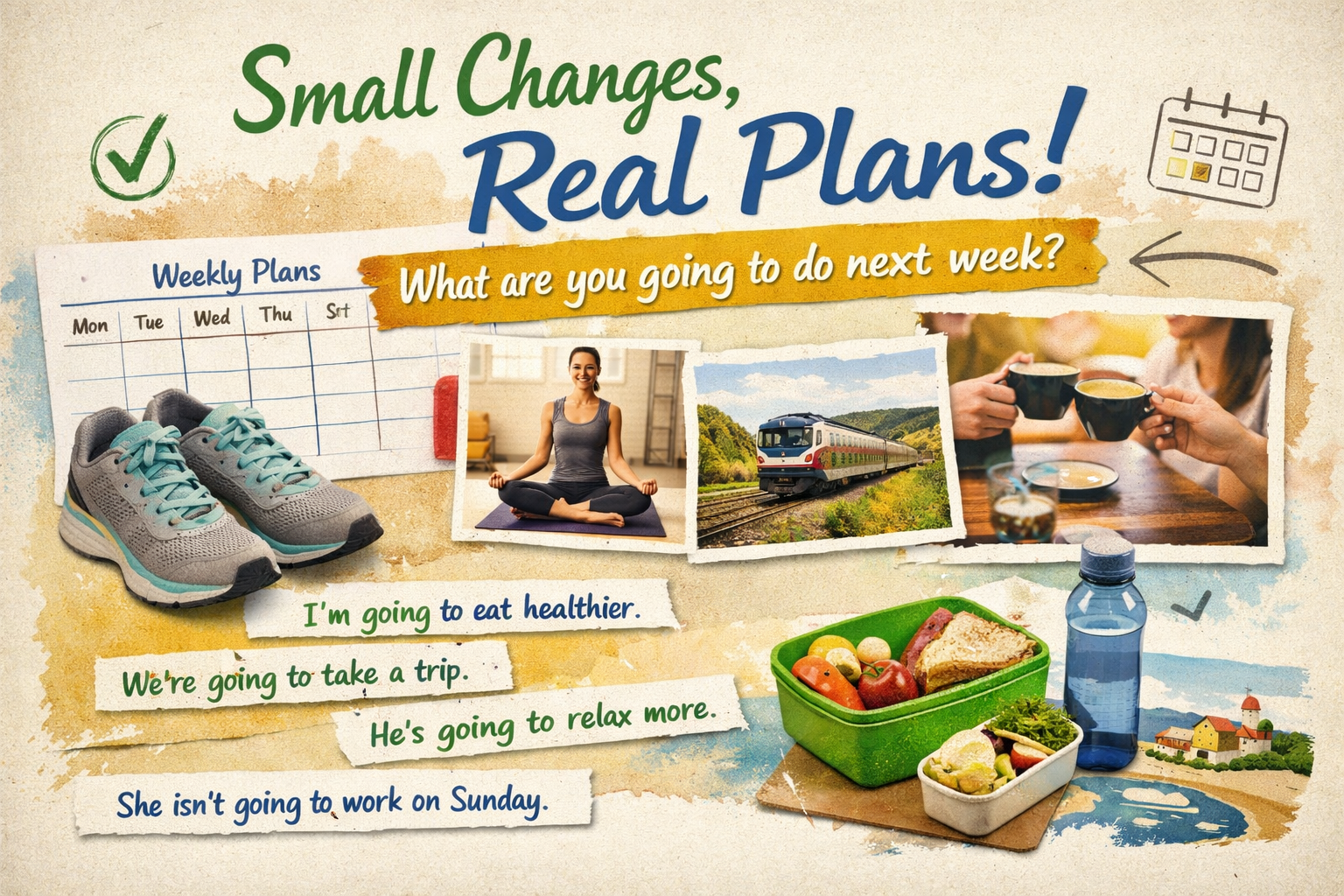
Sofia is tired after a busy month, so she is going to make a few small changes next week. On Monday, she is going to go to bed earlier. On Tuesday, she is going to walk home after work. She is also going to take lunch from home two days a week.
On Friday evening, she isn’t going to stay in the city. She is going to take a short train trip to a nearby town with a friend. They are going to have coffee, walk by the sea, and come back the same day. Sofia says she is not going to change everything. She is only going to do simple things that help her feel calmer and healthier.
Guided Practice (12–15′)
Gap-fill (8 items)
Complete with am / is / are going to + verb.
- I __________ __________ (cook) at home tonight.
- She __________ __________ (take) a short break on Friday.
- We __________ __________ (not stay) out late.
- They __________ __________ (visit) a nearby village.
- He __________ __________ (drink) more water this week.
- __________ you __________ __________ (walk) after work?
- __________ Marta __________ __________ (join) the yoga class?
- My friends __________ __________ (not travel) far this weekend.
Word order (6 items)
- going / I / am / this weekend / to / rest
- she / going / is / healthier food / to / eat
- are / we / going / by train / to / travel / ?
- not / they / going / are / to / work / on Sunday
- going / he / is / to / meet / a friend / after work
- going / you / are / to / take / a break / ?
Speaking Drills (8–10′) – substitution / pair Q&A using target
Substitution drill:
- I’m going to go for a walk.
Change: - after work
- on Saturday morning
- with my sister
- in the park
- before dinner
Pair Q&A:
- Are you going to do exercise this week?
- Are you going to cook anything healthy?
- Are you going to meet anyone this weekend?
- Are you going to stay at home on Sunday?
- Are you going to take a short trip soon?
- Are you going to change one habit this month?
Fast Finishers (3–5′) – quick extension
Write three true sentences:
- one plan for health
- one plan for free time
- one plan for a mini-break
Lesson 2 (60′)
Transformation (10–12′) – to negative / to question (10 items)
Change each sentence to the negative and the question.
- I am going to cook tonight.
- She is going to take a train on Friday.
- We are going to walk after work.
- He is going to rest on Sunday.
- They are going to visit friends this weekend.
- Marta is going to join the class.
- My brother is going to eat less sugar.
- We are going to stay in a small hotel.
- I am going to drink more water.
- They are going to go to the coast.
Reading/Listening Mini-task (10–12′) – short comprehension (6 Qs: 4 objective + 2 open)
A Simple Plan for April
Liam has decided to make April calmer and healthier. He is going to change a few small things, not his whole life. During the week, he is going to leave work on time two days a week. He is going to walk for twenty minutes after dinner, and he is going to take lunch from home on Mondays and Wednesdays. He isn’t going to use his phone so much before bed.
At the weekend, Liam and his partner are going to take one small trip every two weeks. They are not going to travel far or spend a lot of money. This Saturday, they are going to visit a town near the coast. They are going to have lunch, walk around, and come home in the evening. Liam thinks simple plans are easier to keep.
Questions:
- True or False: Liam is going to change everything in his life.
- True or False: He is going to walk after dinner.
- Multiple choice: On which days is he going to take lunch from home?
a) Tuesday and Thursday
b) Monday and Wednesday
c) Friday and Saturday - Multiple choice: This Saturday, Liam is going to go
a) to a mountain village
b) to a city abroad
c) to a town near the coast - What isn’t Liam going to use so much before bed?
- Why does Liam like simple plans?
Personal Q&A (10′) – scaffolded interview prompts
Student A asks, Student B answers. Then change.
Prompts:
- What are you going to do after class today?
- Are you going to do anything healthy this week?
- Are you going to meet a friend soon?
- Where are you going to go next weekend?
- Are you going to stay at home on Sunday?
- What habit are you going to change a little?
Sentence stems:
- I’m going to…
- I’m not going to…
- Yes, I am. / No, I’m not.
- This weekend, I’m going to…
Communicative Task (15′) – pair/group outcome (role-play/info-gap)
Plan a realistic mini-reset week
In pairs, students plan one week for a tired adult called Alex.
Choose:
- two healthy plans
- one after-work activity
- one mini-break
- one thing Alex is not going to do
Planner headings:
- Monday
- Wednesday
- Friday
- Saturday
Useful language:
- Alex is going to…
- He’s not going to…
- On Friday, he’s going to…
- On Saturday, he’s going to…
Outcome:
Pairs present their plan in 5–6 sentences.
Exit Ticket (3′) – one quick check item
Write one true sentence:
Next week, I’m going to ____________.
Homework
A: core (10–12 items)
Complete with the correct form of going to.
- I __________ __________ (rest) tonight.
- She __________ __________ (not cook) on Friday.
- __________ you __________ __________ (go) out tomorrow?
- We __________ __________ (visit) my sister this weekend.
- He __________ __________ (drink) more water.
- They __________ __________ (not stay) in a hotel.
- __________ Marta __________ __________ (take) the train?
- My parents __________ __________ (walk) by the sea.
- I __________ __________ (not use) my phone so much.
- What __________ you __________ __________ (do) on Sunday?
- He __________ __________ (meet) a friend after work.
- We __________ __________ (not travel) far next month.
B: optional challenge (for fast learners)
Write 80–100 words:
My simple plan for next week
Include:
- one healthy habit
- one plan after work
- one mini-break
- one thing you are not going to do