Introduction: A Very Important Deadline
A deadline is the final time to finish or deliver something. Mark had a very important deadline that day. He had finished a report for his boss, and he had to hand it over in the Málaga office before 2 p.m.
The problem was simple: Mark was in Estepona, the report was not printed, and the road to Málaga was never easy at that time of day.
Problem 1: The Only Person in the Office
That morning, something unexpected happened. Mark’s colleague had to leave the office early because of a personal problem. Suddenly, Mark was the only person who could print the report and take it to Málaga.
His boss called him and said, “Mark, this report is really important. Please don’t be late.”
Mark looked at the clock. It was already 11:30.
Problem 2: The Printer Refused to Work
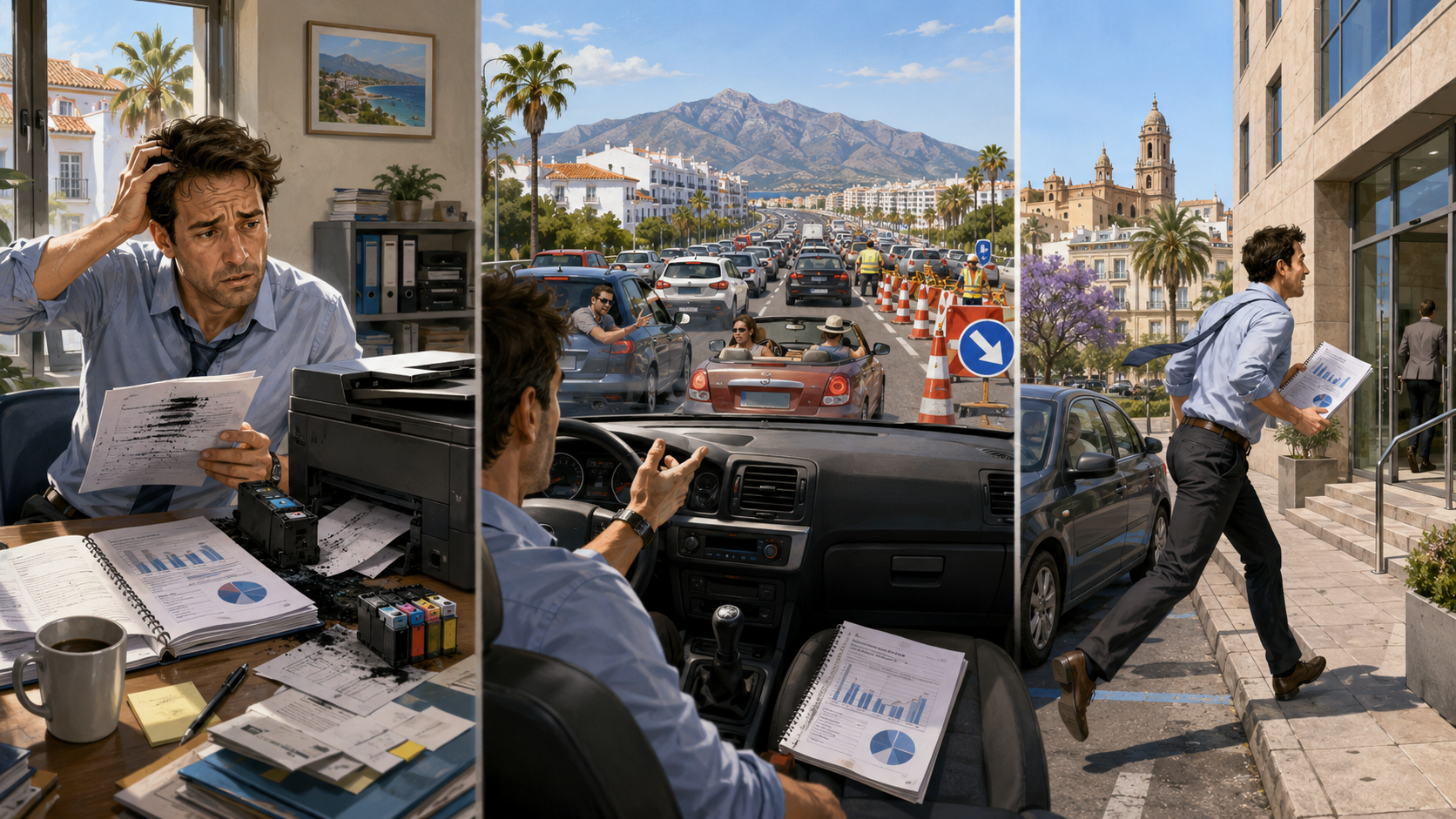
Mark opened the file and pressed “print”. Nothing happened.
First, the printer had no paper. Mark found some paper and tried again. Then the printer had no ink. He changed the cartridge and pressed “print” again. After that, there was a paper blockage inside the machine.
Mark was trying to fix it when the phone rang again. It was his boss.
“Everything is fine,” Mark said.
But everything was not fine. He had already lost twenty-five minutes.
Problem 3: The Road to Málaga
Finally, Mark got into his car and left Estepona.
At first, the traffic was slow but normal. Then, near San Pedro, everything stopped. There were road works, tourists in rental cars, and people driving too fast because they were late for work.
Some drivers were shouting. Others were changing lanes every ten seconds. One man sounded his horn again and again, although nobody could move.
Mark looked at the report on the passenger seat and said, “Please, not today.”
Problem 4: No Parking
When Mark arrived in Málaga, it was almost 2 p.m.
He needed to find parking quickly, but every street was full. He tried one public car park, but there were no free spaces. He tried another one. Full again.
Finally, he found a parking space in a third car park. He took the report, closed the car door, and ran to the office.
Conclusion: A Little Late
Mark arrived at reception at 2:08. He was tired, stressed, and a little embarrassed.
His boss looked at the clock. Then he looked at Mark.
Mark gave him the report and said, “I’m sorry. The printer, the traffic, and Málaga parking worked together against me.”
His boss opened the report and read the first page. Then he smiled.
“Eight minutes late,” he said, “but the report is excellent.”
Story Structure: Invent Your Own Deadline Story
Title
Title: ?
Introduction: The Deadline
Character: ?
Place: ?
Deadline: ?
Time limit: ?
Why is it important: ?
Paragraph 1: The First Problem
What unexpected thing happens: ?
Who cannot help: ?
What does the character have to do alone: ?
How much time does the character have: ?
Paragraph 2: A Technical Problem
Object or machine: ?
What goes wrong first: ?
What goes wrong next: ?
How much time does the character lose: ?
How does the character feel: ?
Paragraph 3: The Journey
Transport: ?
Destination: ?
What is the traffic/weather/situation like: ?
What are other people doing: ?
What makes the journey worse: ?
Paragraph 4: The Final Obstacle
What is the character looking for: ?
What is difficult to find: ?
Where does the character try first: ?
Where does the character try next: ?
What happens at the last minute: ?
Conclusion: The Result
Arrival time: ?
Was the character late or on time: ?
Who receives the important thing: ?
What does the character say: ?
How does the other person react: ?
Final feeling: ?
Grammar Boxes: Course Review
1. Verb to be
Use to be to describe people, places, feelings and situations.
Affirmative
I am tired.
You are busy.
He is late.
She is at work.
It is important.
We are ready.
They are in class.
Negative
I am not tired.
He isn’t late.
They aren’t ready.
Questions
Are you ready?
Is he at work?
Are they late?
2. There is / There are
Use this to say that something exists in a place.
Singular
There is a problem.
There is a printer in the office.
There is no paper.
Plural
There are many cars.
There are road works.
There are no parking spaces.
Questions
Is there a problem?
Are there many cars?
Is there any paper?
3. Present Simple
Use the Present Simple for routines, facts and general situations.
Affirmative
I work in Estepona.
He drives to Málaga.
They finish work at six.
Negative
I don’t work on Sundays.
He doesn’t drive fast.
They don’t like traffic.
Questions
Do you work in an office?
Does he drive to Málaga?
Do they finish late?
4. Adverbs of Frequency
Use these words to say how often something happens.
Always
I always arrive early.
Usually
He usually prints the report.
Often
We often have meetings.
Sometimes
They sometimes work from home.
Never
She never forgets a deadline.
Position
He usually arrives on time.
They don’t usually arrive late.
Do you usually drive to work?
5. Present Continuous
Use the Present Continuous for actions happening now or around now.
Form
am / is / are + verb-ing
Affirmative
I am working.
He is printing the report.
They are waiting.
Negative
I’m not driving.
He isn’t listening.
They aren’t working.
Questions
Are you working?
Is he printing the report?
Are they waiting?
6. Present Simple vs Present Continuous
Use Present Simple for routines.
Use Present Continuous for now.
Routine
Mark usually drives to work.
Now
Today, Mark is driving to Málaga.
Routine
The printer usually works well.
Now
The printer isn’t working.
Routine
People often park in the city centre.
Now
Mark is looking for parking.
7. Past Simple
Use the Past Simple for finished actions in the past.
Regular verbs
work → worked
arrive → arrived
finish → finished
open → opened
Irregular verbs
go → went
have → had
make → made
find → found
leave → left
take → took
drive → drove
give → gave
Affirmative
Mark arrived late.
He opened the file.
He drove to Málaga.
Negative
Mark didn’t arrive early.
He didn’t open the email.
They didn’t find parking.
Questions
Did Mark arrive late?
Did he print the report?
Did they find a space?
8. Past Simple: was / were
Use was / were as the past of to be.
Affirmative
I was tired.
He was late.
The report was important.
We were stressed.
They were angry.
Negative
I wasn’t tired.
He wasn’t ready.
They weren’t calm.
Questions
Was he late?
Was the report important?
Were they angry?
9. Past Continuous
Use the Past Continuous for an action in progress in the past.
Form
was / were + verb-ing
Affirmative
Mark was driving.
He was printing the report.
People were shouting.
Negative
Mark wasn’t sleeping.
They weren’t waiting calmly.
Questions
Was Mark driving?
Were people shouting?
10. Past Simple + Past Continuous
Use Past Continuous for the background action.
Use Past Simple for the event that interrupts it.
Examples
Mark was driving when the traffic stopped.
He was printing the report when the phone rang.
People were waiting when the road works started.
Mark was looking for parking when his boss called.
Structure
I was ______ when ______.
He was ______ when ______.
They were ______ when ______.
11. Present Perfect
Use the Present Perfect for experiences, recent results, or unfinished time.
Form
have / has + past participle
Affirmative
I have finished the report.
He has lost time.
They have arrived.
Negative
I haven’t finished.
He hasn’t printed the report.
They haven’t found parking.
Questions
Have you finished?
Has he arrived?
Have they printed the report?
12. Present Perfect vs Past Simple
Use Past Simple when the time is finished or specific.
Use Present Perfect when the result is important now.
Past Simple
Mark finished the report yesterday.
He printed it at 12:15.
He arrived at 2:08.
Present Perfect
Mark has finished the report.
The printer has stopped.
He has lost a lot of time.
Compare
He lost twenty minutes this morning.
He has lost twenty minutes, so now he is late.
13. Already / Yet / Ever / Never
Use these words with the Present Perfect.
Already = before now
Mark has already finished the report.
Yet = until now, usually questions and negatives
Has he printed the report yet?
He hasn’t found parking yet.
Ever = in your life
Have you ever missed a deadline?
Never = not in your life
I have never missed an important deadline.
14. Have to / Had to
Use have to for obligation.
Present
I have to work.
He has to print the report.
They have to arrive on time.
Negative
I don’t have to drive.
He doesn’t have to call.
Question
Do you have to work today?
Does he have to go to Málaga?
Past
I had to work yesterday.
He had to print the report.
They had to wait.
Past negative
I didn’t have to drive.
He didn’t have to call.
Past question
Did you have to work yesterday?
Did he have to go to Málaga?
15. Going to
Use going to for plans and intentions.
Form
am / is / are + going to + verb
Affirmative
I am going to call my boss.
He is going to drive to Málaga.
They are going to finish the report.
Negative
I’m not going to be late.
He isn’t going to stop.
They aren’t going to wait.
Questions
Are you going to call?
Is he going to drive?
Are they going to finish?
16. Future with will
Use will for quick decisions, promises or predictions.
Quick decision
I’ll call him now.
Promise
I’ll send the report today.
Prediction
The traffic will be terrible.
Negative
I won’t be late.
He won’t forget the report.
Question
Will you arrive on time?
Will he finish the report?
17. Comparatives and Superlatives
Use comparatives to compare two things.
Comparative
fast → faster
slow → slower
easy → easier
difficult → more difficult
important → more important
Examples
Traffic in Málaga is slower than traffic in Estepona.
This report is more important than the last one.
Parking is more difficult in the city centre.
Use superlatives to compare one thing with all the others.
Superlative
fast → the fastest
slow → the slowest
easy → the easiest
difficult → the most difficult
important → the most important
Examples
This is the most important report of the month.
Málaga is the most difficult place to park.
Today is the worst day for traffic.
18. Countable and Uncountable Nouns
Countable nouns
a car / two cars
a report / three reports
a problem / many problems
Uncountable nouns
traffic
paper
ink
time
work
information
Examples
There are too many cars.
There is too much traffic.
He has a lot of work.
The printer has no ink.
Mark doesn’t have much time.
19. Some / Any / No
Use some in affirmative sentences.
Use any in questions and negatives.
Use no to mean zero.
Some
There is some paper.
There are some cars outside.
Any
Is there any paper?
There isn’t any ink.
Are there any parking spaces?
No
There is no paper.
There are no free spaces.
There is no time.
20. Basic Connectors for Stories
Use connectors to organise events.
Beginning
First, Mark opened the file.
At first, everything was normal.
Next events
Then the printer stopped.
After that, he changed the ink.
Later, he got into his car.
Problems
Unfortunately, there was a traffic jam.
Suddenly, everything stopped.
Contrast
But the printer didn’t work.
However, he didn’t give up.
Ending
Finally, he arrived.
In the end, his boss accepted the report.
Easy General Knowledge Quiz
- What colour do you get when you mix red and white?
- How many days are there in a week?
- What is the capital city of Spain?
- Which animal says “meow”?
- How many legs does a spider have?
- What do bees make?
- Which planet do we live on?
- What is the opposite of hot?
- What do we use to tell the time?
- Which fruit is long and yellow?
- How many months are there in a year?
- What language do people speak in France?
- What do you drink when you are thirsty?
- Which animal is known as “the king of the jungle”?
- What do you use to write on a whiteboard?
Languages Around the World
The Most Spoken Languages
People speak many different languages around the world. Some countries have one main language, but other countries have many languages. When we count all speakers, including second-language speakers, English is usually the most spoken language in the world. Mandarin Chinese is second, Hindi is third, and Spanish is fourth.
However, the order can change if we count only native speakers. Mandarin Chinese has more native speakers than English, but many people learn English as a second language for work, travel, study and the internet.
Languages and Culture
A language is not only a group of words. It is also part of a culture. Through language, people tell stories, sing songs, make films, write books and share ideas.
Spanish is important because it connects many countries in Europe, Latin America and other parts of the world. Millions of people use Spanish in family life, music, cinema, sport, business and social media.
English is also very important in culture. Many songs, films, series, websites and video games use English. A person does not need perfect English to enjoy these things. Sometimes, a little English is enough to understand a song, read a message or travel more easily.
English as a Lingua Franca
A lingua franca is a language that people use when they do not have the same first language. For example, a Spanish person and a German person may use English to communicate. In this situation, English is not their native language, but it is useful for both of them.
Today, many people see English as the world’s main lingua franca. It is common in international business, airports, tourism, science, technology and online communication. The British Council also describes English as very important for global trade and international communication.
This does not mean that English is better than other languages. It means that English is useful because many people have studied it. In many situations, English works like a bridge between people from different countries.
What Is the Future?
The future of languages is difficult to predict. English will probably continue to be very important, but other languages are also growing. Mandarin Chinese is important because China has a large population and a strong economy. Spanish is also growing because it has many speakers and a strong cultural presence.
In some places, people mix languages naturally. For example, some people use Spanglish, a mix of Spanish and English. They may speak Spanish at home, use English at work, and mix both languages with friends. This is not always “bad English” or “bad Spanish”. It can be a normal part of bilingual life.
In the future, people may not use only one global language. Maybe the future is multilingual. People may use English for international communication, Spanish or Mandarin for culture and business, and their local language for family and identity.
More Than Words
Languages are more than grammar and vocabulary. They are connected to people’s lives, jobs, families, music, films and ideas. English is very useful today, but every language has value.
Learning English does not mean forgetting another language. It means opening another door. A person who speaks more than one language can understand more people, more cultures and more of the world.
What are the advantages of speaking English?
Which do you consider the most important language now-a-days?
“Language Debate Corners”
Read these four opinions. Do you agree or disagree? Why?
- English will continue to be the world’s lingua franca.
- Spanish will become more important.
- Technology will make language learning less necessary.
- It is better to speak two languages imperfectly than one language perfectly.
- I agree because…
- I don’t agree because…
- In my opinion…
- For work, English is…
- For culture, Spanish is…

