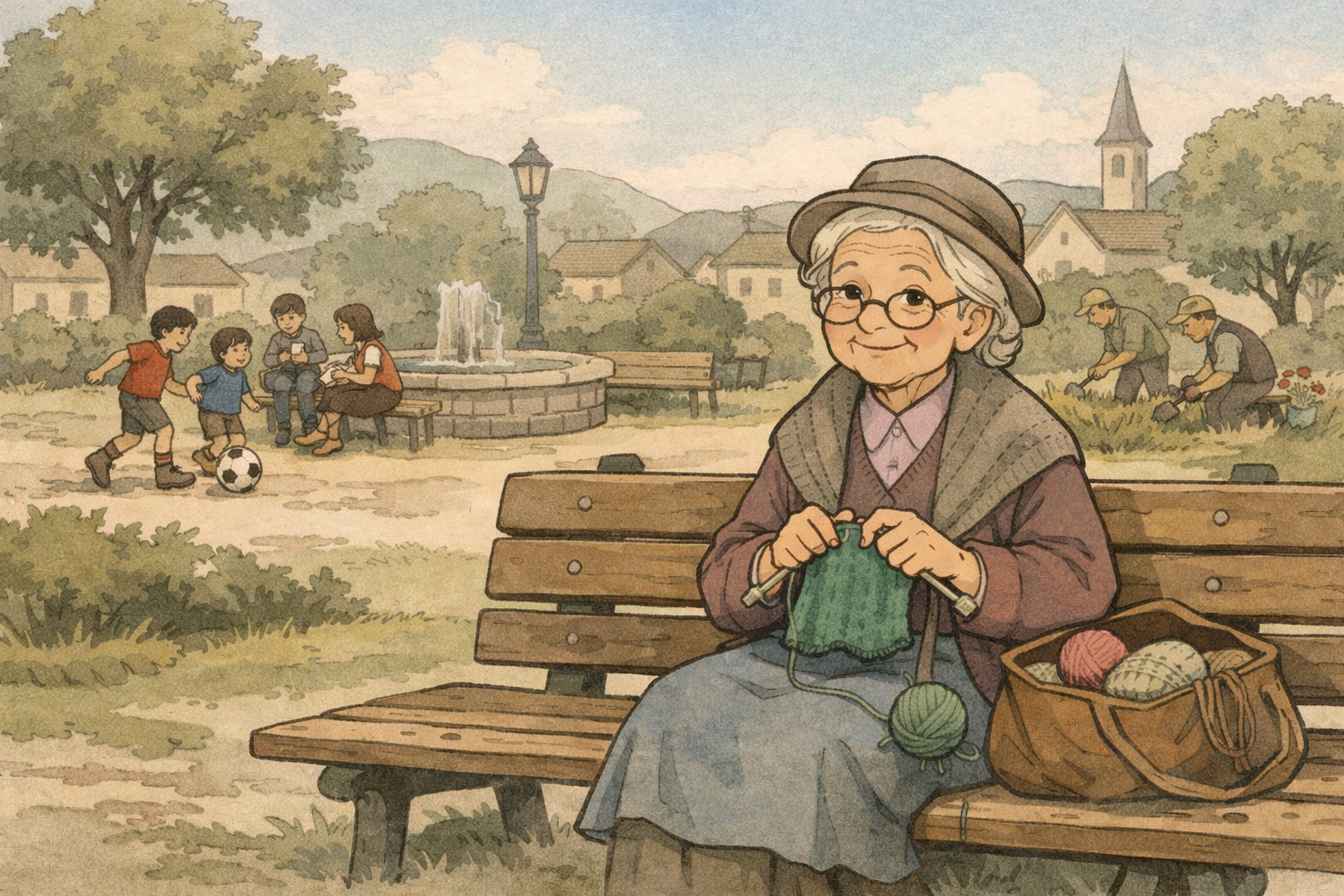
Maria is 87 years old. She is a retired shop assistant. She is sitting on a bench in the town square. She loves knitting, and she always has her knitting in her bag.
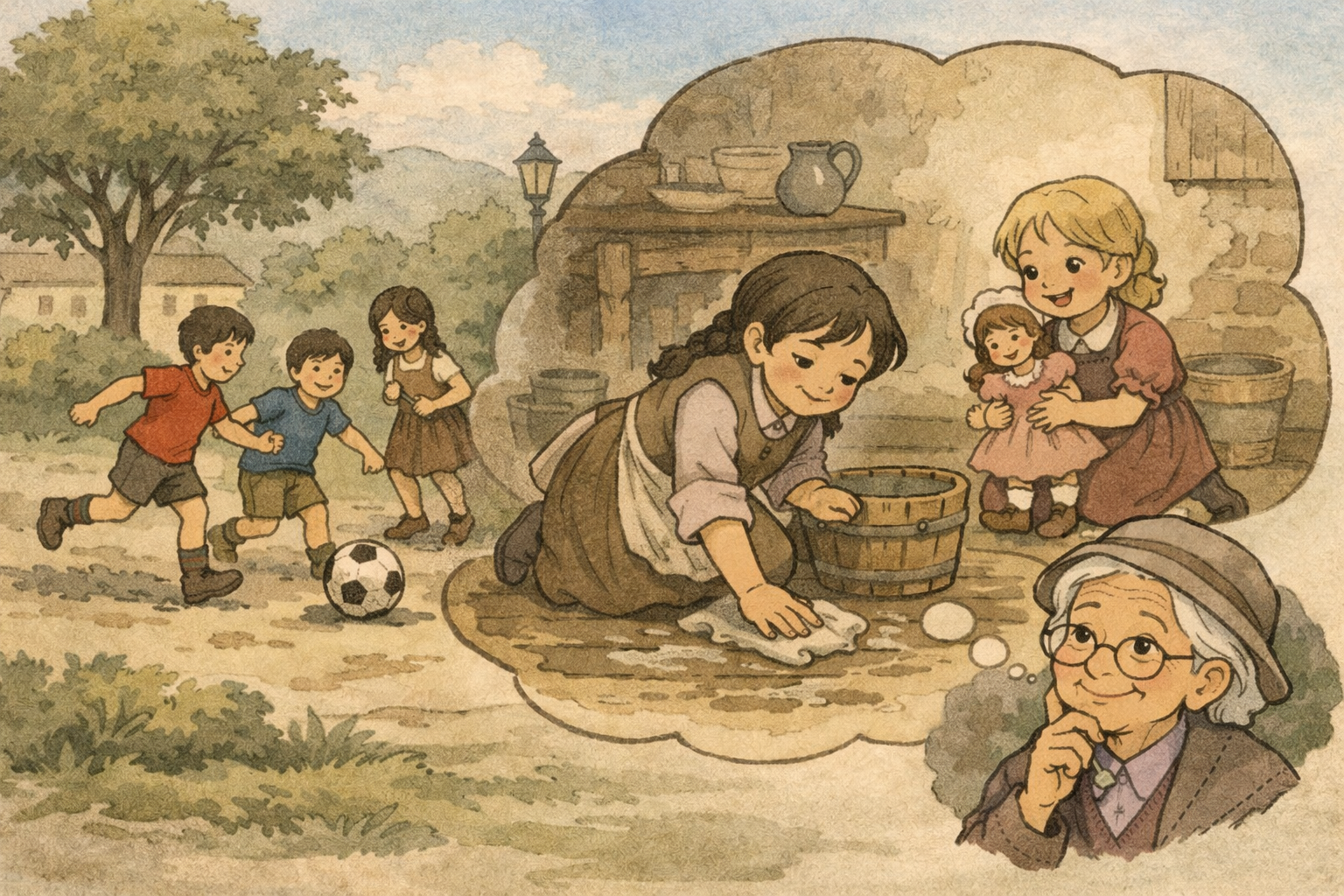
Some children are playing football in the square. They look so fast and happy. I didn’t play football when I was a girl. I worked with my mum in the house. One day, I was cleaning when my cousin arrived, and we played with her doll.
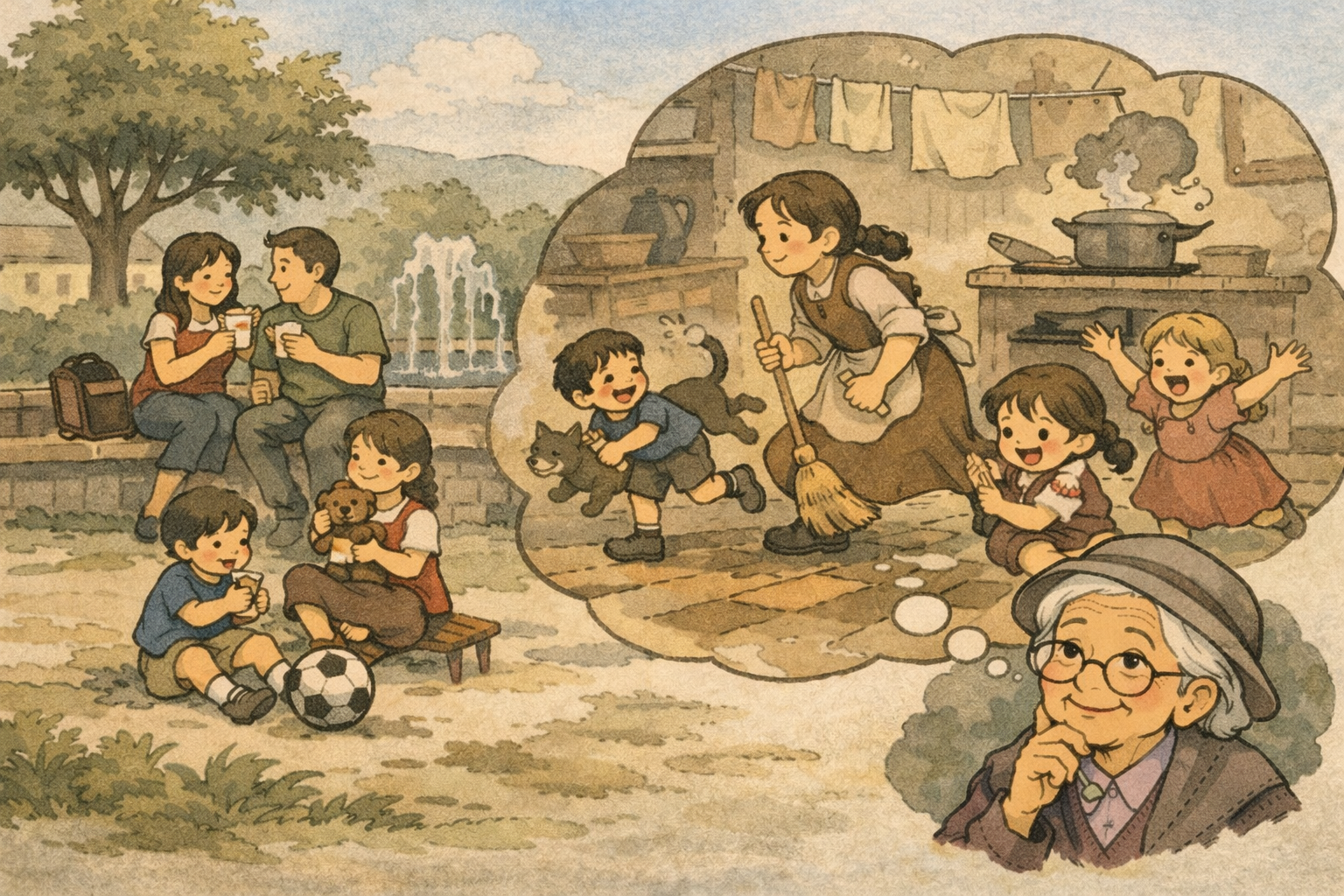
A family is sitting near the fountain. The parents are drinking coffee, and the children are eating snacks. They look calmer than the children with the football. When I was a young mum, I was always busy. I didn’t have a quiet moment while my children were running and shouting.
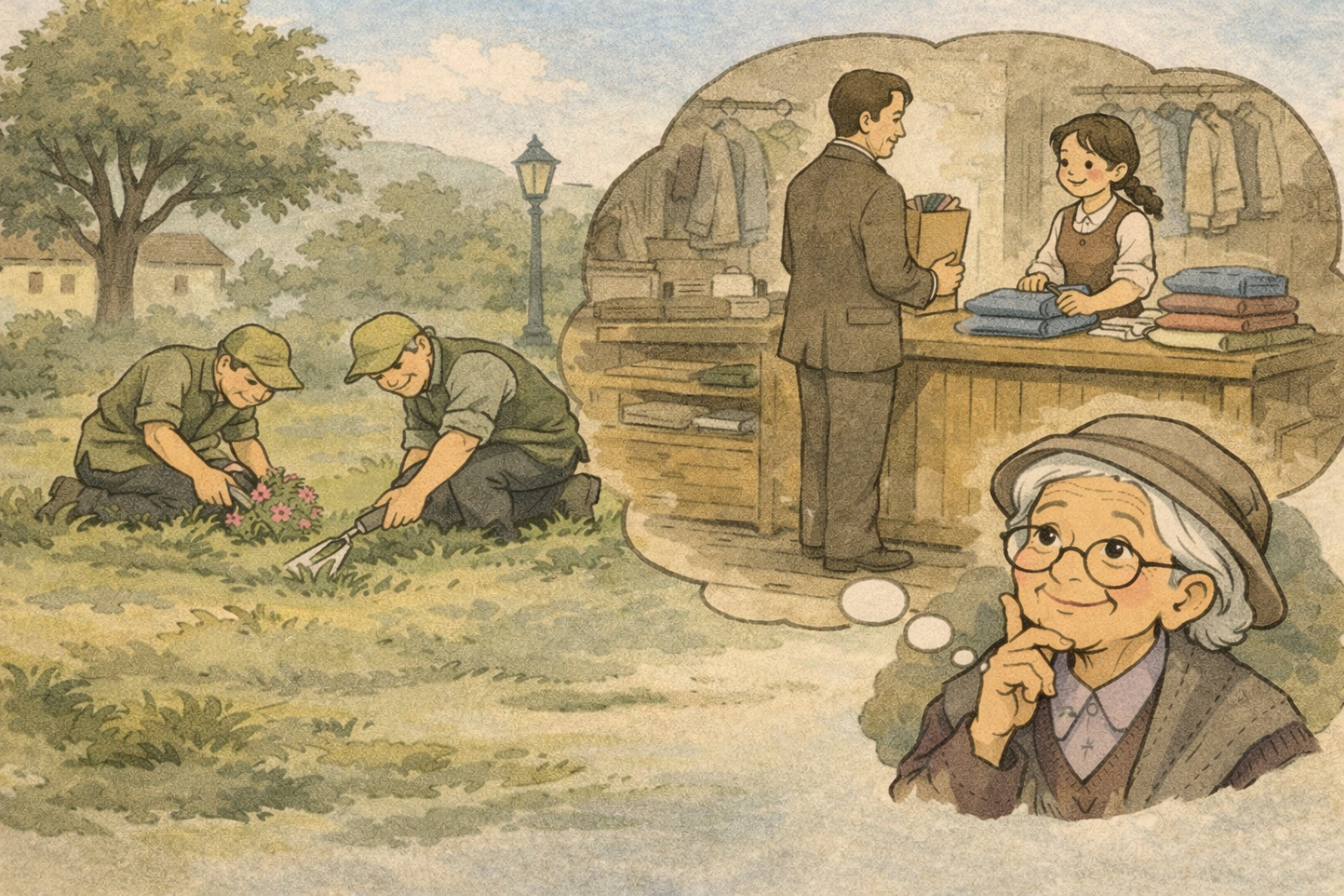
Two gardeners are working on the green area. They are cutting the grass and planting small flowers. Their work is hard, but the park looks more beautiful every week. When I was working in the shop, I stood all day. I was talking to customers while I was folding clothes and putting things on the shelves.
Now Maria smiles and watches the square. She feels lucky. My life has been fantastic.
Answer these questions:
- How old is Maria?
- Where is Maria sitting?
- What does Maria love doing?
- What are the children doing in the square?
- What was Maria doing when her cousin arrived?
DEFINITIONS
Objects
- CHAIR: an object we use for sitting on.
- TABLE: an object we eat or work on.
- PHONE: a thing we use to call people and send messages.
- KEY: a small object we use to open a door.
- BAG: a thing we use to carry our things.
- UMBRELLA: an object we use when it rains.
- CLOCK: an object that tells the time.
- BOTTLE: a container for water or juice.
Animals
- DOG: an animal with four legs that lives with families. You walk the dog every day.
- CAT: a small animal that lives in many homes. It likes sleeping.
- BIRD: a small animal that can fly.
- FISH: an animal that lives in water.
- HORSE: a big animal you can ride.
Jobs
- TEACHER: a person who works in a school with children.
- DOCTOR: a person who helps sick people.
- SHOP ASSISTANT: a person who works in a shop and helps customers.
- COOK: a person who makes food.
- DRIVER: a person who drives a car, bus, or taxi.
People / Family
- MOTHER: a woman in a family who has children.
- FATHER: a man in a family who has children.
- FRIEND: a person you like and spend time with.
- NEIGHBOUR: a person who lives near your home.
Food & Drink
- BREAD: food we eat with butter, cheese, or soup.
- RICE: small white food we cook in water.
- SOUP: hot food we eat with a spoon.
- SALAD: cold food with vegetables.
- APPLE: a fruit that is round and sweet.
- WATER: a drink we need every day.
Absolutely — here are simple speaking frames your A1/A2 ladies can rely on for any word. Keep them on the board all lesson.
Super-safe definition frames (A1/A2)
Frame 1: Basic
It’s a _____.
It’s for _____.
You use it to _____.
Example: A chair
It’s a chair. It’s for sitting. You use it to sit down.
Frame 2: Category + simple details
It’s a kind of _____. (object / animal / food / job / place / person)
It is (big/small/long/round).
It is (colour).
Example: An apple
It’s a kind of food (fruit). It is round. It is red or green.
Frame 3: Place + daily life
You find it in/at _____.
You use it at _____. (time/place)
People use it when _____.
Example: An umbrella
You find it at home or in a shop. People use it when it rains.
Frame 4: “Has got” frame (very useful for objects/animals)
It has got _____.
It hasn’t got _____.
Example: A dog
It has got four legs. It hasn’t got wings.
Frame 5: Actions frame (great for animals / jobs)
It can _____.
It can’t _____.
It likes _____.
Example: A bird
It can fly. It can’t swim (usually). It likes eating seeds.
Frame 6: Job frame (very controlled)
A _____ is a person who _____.
They work in/at _____.
They help _____.
Example: A teacher
A teacher is a person who teaches. They work in a school. They help children.
Frame 7: Food frame (easy + practical)
It’s food.
You eat it for _____. (breakfast/lunch/dinner)
It tastes _____. (sweet/salty/good)
You eat it with _____.
Example: Soup
It’s food. You eat it for lunch. It tastes good. You eat it with a spoon.
Frame 8: “It’s like / It’s different” (gentle A2 comparative review)
It’s like _____.
But it’s (bigger/smaller/sweeter) than _____.
Example: A cat
It’s like a dog. But it’s usually smaller than a dog.
MATCH THE WORDS TO THE DEFINITIONS (A1/A2)
Words (1–5)
- Umbrella
- Nurse
- Sandwich
- Key
- Rabbit
Definitions (A–E)
A) An animal with long ears that can jump. It likes carrots.
B) A person who works in a hospital and helps sick people.
C) A thing you use to open a door. It is small and you can lose it easily.
D) Food with bread and something inside (like cheese or chicken). You eat it for lunch.
E) An object you use when it rains, so you don’t get wet.
Write the answers: 1–__ 2–__ 3–__ 4–__ 5–__

1) “I don’t know the word, but…”
- “I don’t know the word in English, but it’s a kind of …”
- “It’s a thing you use for …”
- “It’s a person who …”
- “It’s a place where …”
- “It’s like … but …”
- “You do it when you …” (for actions)
2) Checking + repair (so it becomes a dialogue, not a speech)
- “Do you mean …?”
- “Is it similar to …?”
- “Can you show me / describe it more?”
- “So, you mean … (rephrase).”
- “Oh, you mean ___.”
3) Keeping the floor (confidence)
- “Let me think…”
- “How can I say it…”
- “It’s not exactly that, but…”
- “One more detail: …”
Dialogue 1: Tow truck (phone to insurance)
Characters:
- Man (M) – stressed, basic English, uses definition frames
- Insurance Lady (L) – calm, helpful, asks short questions
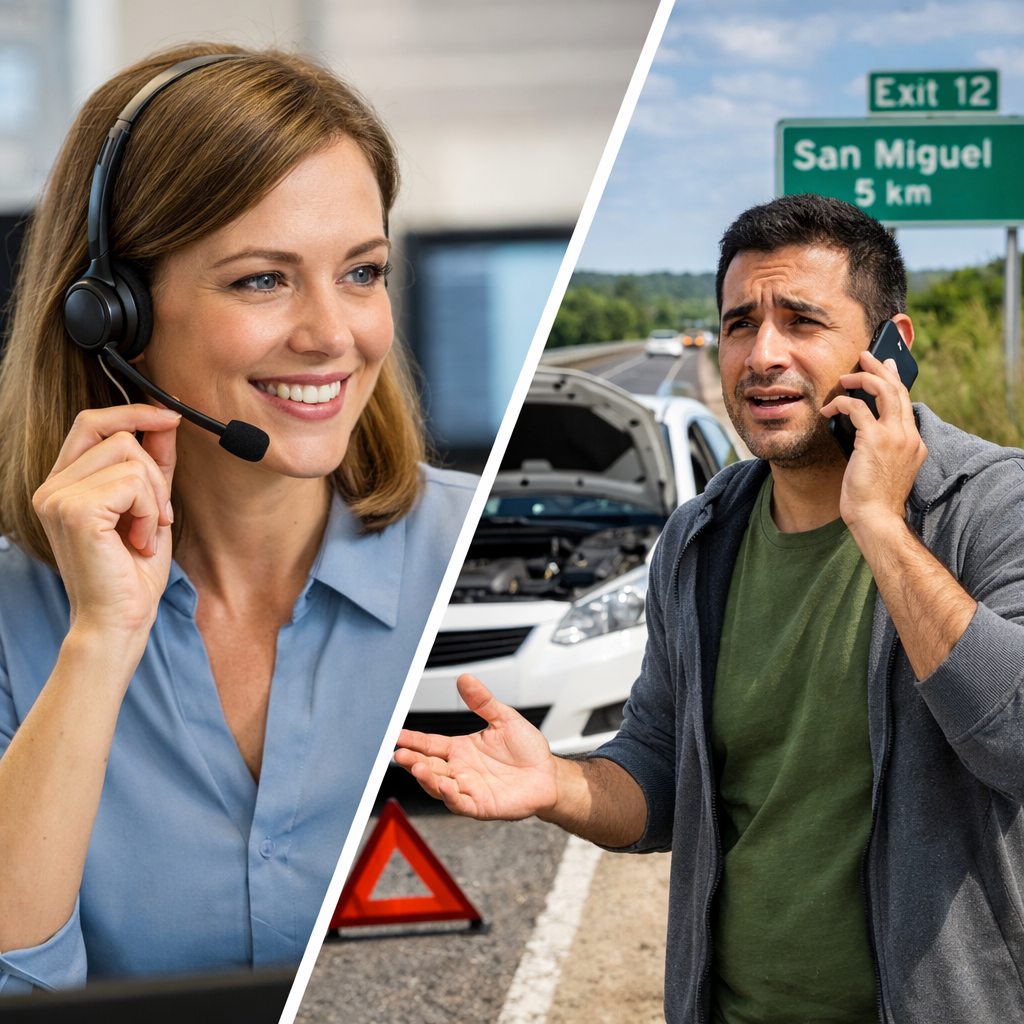
L: Good afternoon. Road assistance. How can I help you?
M: Hello… yes… I need help. My car stop. On the road. I cannot drive.
L: Okay. Are you safe right now?
M: Yes, I am safe. I am on the side. Not in the road.
L: Good. What is your location?
M: I don’t know the word… but it’s a place near the highway.
I see a sign… “Exit 12”… and… big blue sign.
L: Exit 12. Which direction are you going? North or south?
M: Uh… I go to the city. I think… south. Sorry, my English not good.
L: No problem. Tell me the nearest town name on the sign.
M: The sign say… “San Miguel” and “5 km”.
L: Great. What happened to the car?
M: The car make noise and then stop. Now it doesn’t start.
I think the… I don’t know word… the thing you use to make the car go.
L: Do you mean the engine?
M: Yes! Engine. It’s like the “motor”. Thank you.
L: Okay. Do you need a tow truck?
M: Yes. I need… how you say… the big car that takes my car.
L: A tow truck.
M: Yes, tow truck. I don’t know the word, but it’s a kind of truck.
You use it to move a broken car. My car cannot move.
L: Understood. Is the car in a dangerous position?
M: No, it is okay. On the side. But I have no triangle… I don’t know word…
L: Warning triangle?
M: Yes, warning triangle. It’s a thing you put behind the car.
I don’t have it.
L: Okay. Are there passengers with you?
M: Only me.
L: What is your car make and model?
M: It is… I don’t know model. Small white car.
Sorry. I can give you the number plate.
L: Yes, please. The number plate.
M: Plate is… 4 8 2 1… K L M.
L: Thank you. And your name and policy number?
M: My name is Carlos. Policy number… wait… (pause) … 77831.
L: Great. I’m sending a tow truck to you. It will call you. What is your phone number?
M: It is 6 1 2… 3 4 5… 9 0 8.
L: Perfect. While you wait, please stay in a safe place. Do you need a taxi after the tow?
M: Maybe yes. I need go home. I don’t know word…
It’s a car with a driver. You pay. Like… taxi.
L: Yes, a taxi. We can arrange that too.
M: Thank you. And… one more: I need to tell the driver where I am.
It’s a place near Exit 12, San Miguel 5 km.
L: Exactly. I’ve written it down. You did great. Anything else?
M: No. Thank you. Please help.
Dialogue 2: Tow truck arrives (by the road)
Characters:
- Driver (D) – tow truck driver, speaks clearly, short questions
- Man (M) – basic/broken English, uses definition frames
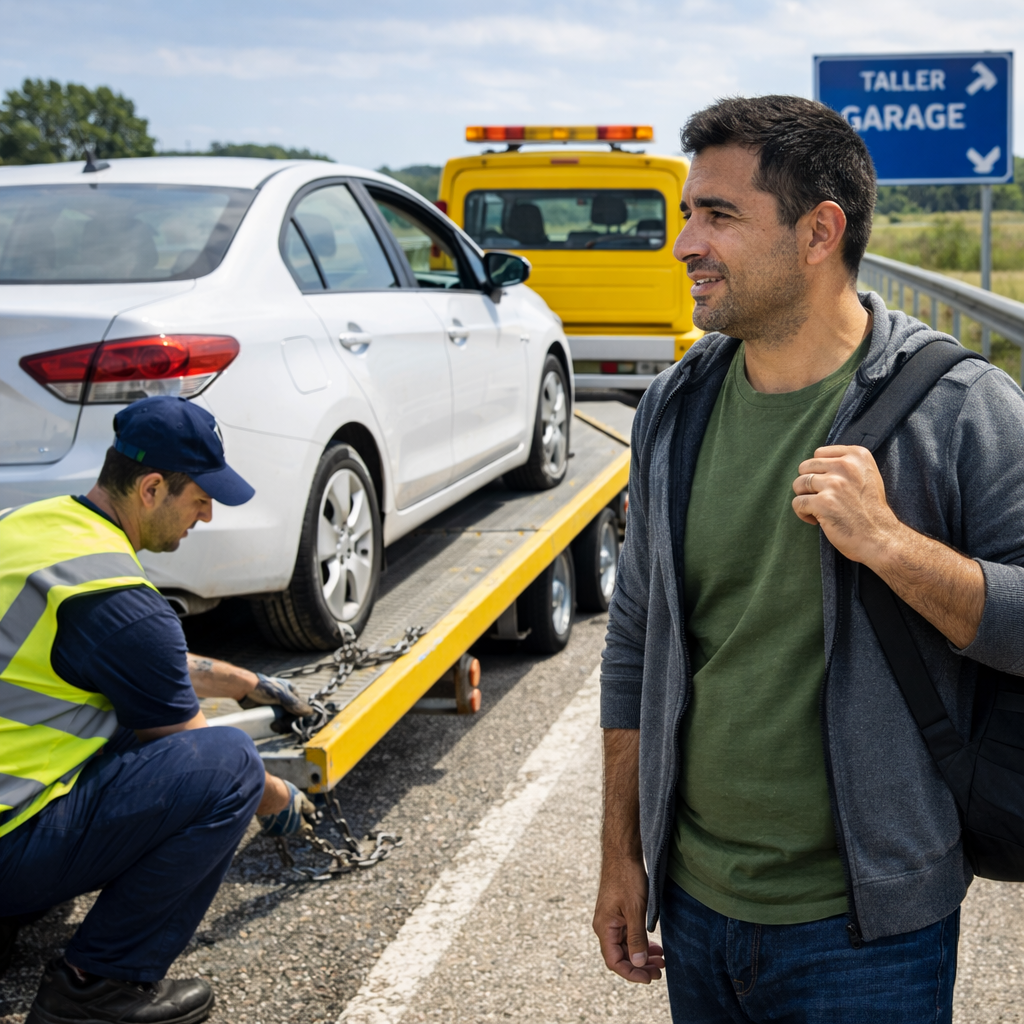
D: Hello! Are you Carlos?
M: Yes, yes. Carlos. Thank you for coming.
D: No problem. I’m the tow truck driver. Is this your car?
M: Yes. My car. It stop… I cannot start.
D: Okay. First: are you safe? You stayed off the road?
M: Yes. I stay here, behind the barrier.
D: Good. What happened?
M: The car make noise… then stop. Now nothing.
I think… the engine. It’s the thing that makes the car go.
D: Got it. Do you have the keys?
M: Yes, keys here.
D: Great. Where do you want to take the car?
M: I don’t know the word… but it’s a place where people fix cars.
D: A garage? A mechanic?
M: Yes! Garage. Mechanic. Thank you.
I want go to… “Auto Pérez” in San Miguel.
D: Okay. Do you know the address?
M: Not full address. But I have on my phone. Wait…
(looks) … It’s on Calle Mayor, number 18.
D: Perfect. Is the car in neutral?
M: Sorry… neutral?
D: Neutral gear. Not drive, not reverse.
M: Ah… I don’t know… I can show you.
It’s like “no speed”.
D: Yes. I’ll check.
M: Thank you.
D: Can you open the car, please?
M: Yes. (opens car)
D: Any valuables inside you want to take out?
M: Valuables…?
D: Important things. Phone, bag, wallet.
M: Ah yes. I take my bag.
Bag is… a thing you use to carry your stuff.
D: Great. I’ll attach the car now. Please stand back.
M: Okay.
D: (works) The front wheels are locked. Can you unlock the steering wheel?
M: Steering wheel…?
D: The wheel you hold to turn the car.
M: Ah yes. It’s a thing you use to turn the car left and right.
I can unlock, yes.
D: Thanks. Also, do you have the handbrake on?
M: Handbrake… I don’t know word.
D: The brake you pull with your hand. For parking.
M: Ah! Yes. It’s like a parking brake. I can take it off.
D: Perfect. All set. You can ride with me, or you can go by taxi.
M: I need taxi too, maybe.
It’s a car with a driver. You pay.
D: Yes, taxi. We can call one after we drop the car.
M: Good. And… how long to the garage?
D: About 10 minutes.
M: Okay. Thank you. My English is not good, sorry.
D: You’re doing fine. You explained everything clearly.
M: Thanks. I just… I don’t know the word, but… I try.
D: That’s the best way. Let’s go.
10 Definition Drills (Tow-truck scenario)
1) Tow truck
T: You need a tow truck. You don’t know the word. Explain it.
S: “I don’t know the word, but it’s a kind of truck. You use it to move a broken car.”
L: “Oh, you mean a tow truck.”
2) Engine
T: Your engine has a problem. Explain “engine.”
S: “It’s the thing that makes the car go.”
L: “Do you mean the engine?”
3) Warning triangle
T: You don’t have a warning triangle. Explain it.
S: “It’s a thing you put behind the car to show danger.”
L: “Ah, a warning triangle.”
4) Number plate
T: Give the number plate. Explain “number plate.”
S: “It’s the numbers and letters on the car. It’s on the back (and front).”
L: “Right, the number plate.”
5) Exit (highway)
T: You are near Exit 12. Explain “exit.”
S: “It’s a place where you leave the highway.”
L: “Okay, the exit.”
6) Barrier (by the road)
T: You stayed behind the barrier. Explain “barrier.”
S: “It’s a metal thing next to the road. It protects people.”
L: “Yes, the barrier.”
7) Garage / mechanic
T: You want to take the car to a garage. Explain “garage.”
S: “It’s a place where people fix cars.”
L: “You mean a garage / mechanic.”
8) Steering wheel
T: The driver says “steering wheel.” Explain it.
S: “It’s the wheel you hold. You use it to turn left and right.”
L: “Right, the steering wheel.”
9) Handbrake / parking brake
T: Explain “handbrake.”
S: “It’s a brake you pull with your hand. You use it when you park.”
L: “Ah, the handbrake.”
10) Taxi
T: You need a taxi. Explain “taxi.”
S: “It’s a car with a driver. You pay to go.”
L: “Okay, a taxi.”
We are not going to study, let’s just talk
Classroom notes:
I like video games
I play tennis
I like watching movies / films
I work in construction and decoration
INTRODUCE YOURSELF
I’m 53 years old I’m from Estepona
I like walking I like trekking
How often do you practice yoga?
I practice yoga two days a week
I like reading books
Purchase department in a five star hotel
Purchase = shopping
Beverage = drink
I like doing pilates
WEIGHTLIFTING: this is a sport in which you lift (elevate) very heavy irons. You do this in a gym.
SPORTS and VERBS
PLAY GO DO / PRACTICE
Ball games -ing rest
DEFINITIONS:
It is rectangular, it can be colour but normally is black or gray. It talks or plays music.
A radio
It can be digital. It can be used netless / offline. It has a strap. It is small. It is round or square. A watch.
It is long, it can be thick and thin and you are very comfortable sleeping under it. BLANKET.
ELSE means something different or more. F.e. you had lunch in a restaurant, and the waiter asks you: ‘do you want anything else?’
Truck = Lorry a big vehicle for transporting cargo
Bus – a big vehicle which transports people
Practice makes perfect
 Lingua-Franca