

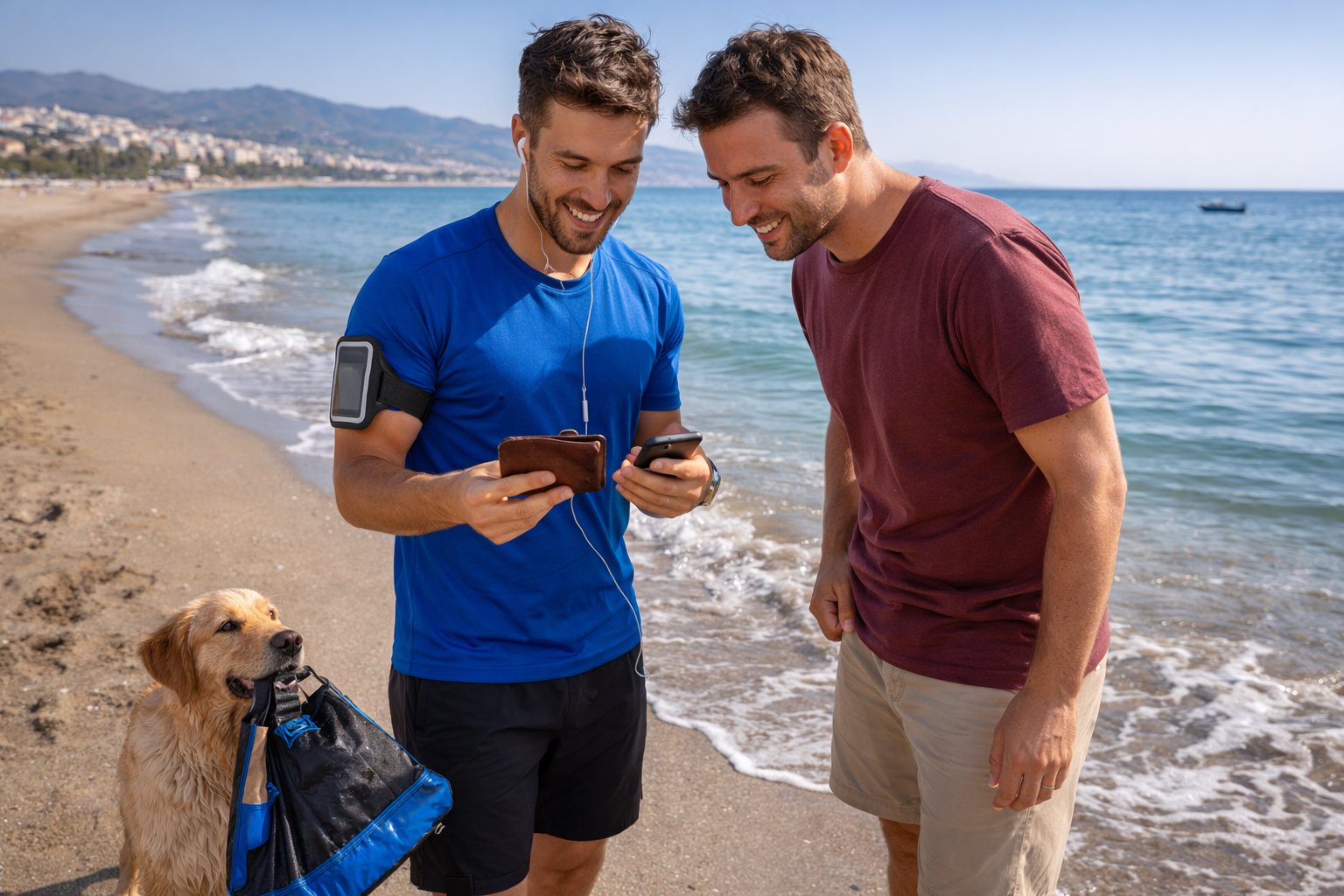
Last Saturday, Tony was running along the beach on a sunny morning. The sun was shining and a few people were walking near the water. While Tony was listening to music, he saw his friend Pete. Pete was standing by some rocks and was looking at the sea. Tony stopped and asked what was wrong.
Pete said he saw a small boat. The boat was moving slowly, but nobody was driving it. While they were watching, a bag fell into the water. Tony ran to the shore and he picked up the bag when it came back with the waves. Inside, he found a phone and a wallet.
Past Continuous vs Past Simple (Story grammar)
| Tense | Form | Use | Signal words | Example (your sentence) |
|---|---|---|---|---|
| Past Continuous | was/were + verb-ing | A longer action in the past (background). Something was in progress. | while, when | I was sleeping siesta… |
| Past Simple | verb (past) / did + base (negative/question) | A finished action in the past. Often a short action that interrupts. | when, suddenly | …when the phone company rang! |
How they combine (most common pattern):
✅ Past Continuous (long action) + when + Past Simple (short interrupting action)
I was sleeping siesta when the phone company rang!
Other common pattern:
✅ Past Simple + while + Past Continuous
The phone company rang while I was sleeping siesta.
Practice Past Simple and Continuous

Paragraph 3A: Rescue at the beach
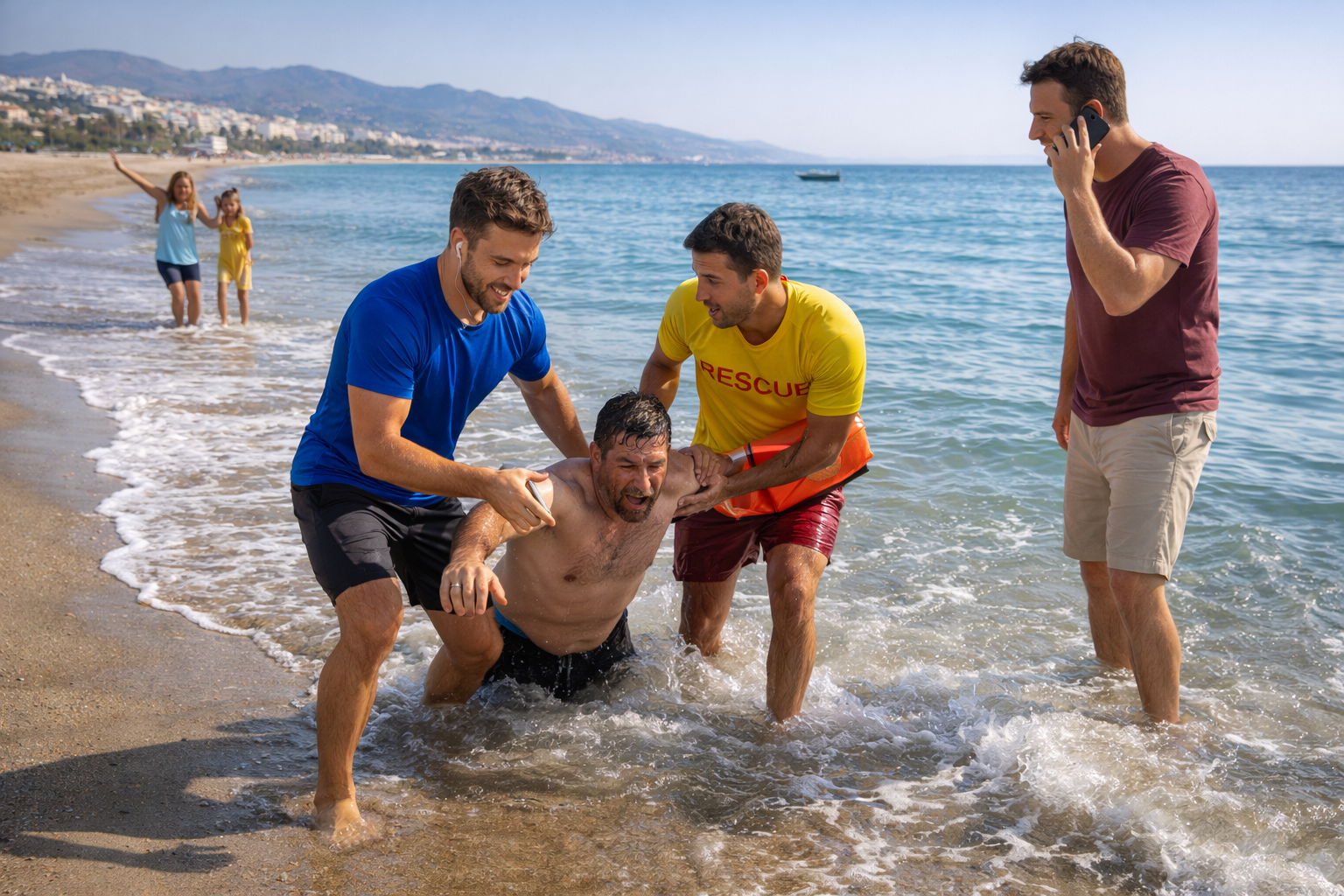
A few minutes later, Tony and Pete (walk) ________ along the shore and (talk) ________ about the bag. While they (look) ________ at the sea, they (hear) ________ someone shouting. A woman (wave) ________ her arms near the water, and a child (cry) ________. Tony (run) ________ closer and (see) ________ a man in the sea. He (try) ________ to swim, but he (get) ________ tired.
Pete (call) ________ for help and Tony (take off) ________ his shoes. While Tony (go) ________ into the water, a lifeguard (arrive) ________ with a float. Together, they (pull) ________ the man to the beach. The man (sit) ________ on the sand and (thank) ________ them, and everyone (feel) ________ relieved.
Homework:
Paragraph 3B: A small emergency (a bit calmer)
After the rescue, Tony and Pete (sit) ________ on the sand and (drink) ________ some water. While they (rest) ________, they (notice) ________ a woman near the rocks. She (look) ________ upset and (search) ________ in her bag. Tony (walk) ________ to her and (ask) ________ if she was okay. She (say) ________ she (lose) ________ her keys. While Tony (look) ________ around, Pete (spot) ________ something shiny in the sand. He (pick up) ________ the keys and (give) ________ them to the woman. She (smile) ________ and (say) ________ thank you.
Paragraph 3C: The boat mystery continues (story-style)
Later, Tony and Pete (walk) ________ back along the beach. While they (walk) ________, they (see) ________ the small boat again. It (move) ________ slowly near the shore, and nobody (sit) ________ inside. Tony (point) ________ at it and Pete (say) ________ it was strange. While they (watch) ________, the boat (turn) ________ and (hit) ________ a rock. Suddenly, a man on the beach (shout) ________ and (run) ________ towards the water. He (tell) ________ them it was his boat. Tony and Pete (help) ________ him pull it closer, and the man (thank) ________ them again.
REVIEW:
| Topic | + Form | – Form | Use | Example (+ / –) |
|---|---|---|---|---|
| To be (Present Simple) | am/is/are | am not / isn’t / aren’t | identity, feelings, place | I’m happy. / I’m not happy. |
| Present Simple | V / V+s | don’t/doesn’t + V | routines, facts | He plays. / He doesn’t play. |
| Have got | have/has got | haven’t/hasn’t got | possession | She’s got a bike. / She hasn’t got a bike. |
| Can / can’t | can + V | can’t + V | ability, permission | I can drive. / I can’t drive. |
| Like / don’t like | like + noun/ing | don’t/doesn’t like + noun/ing | preferences | We like tea. / We don’t like tea. |
| Comparatives | adj-er / more + adj | not + comparative | compare 2 things | It’s bigger. / It isn’t bigger. |
| Superlatives | the adj-est / the most + adj | not + superlative | #1 in a group | It’s the cheapest. / It isn’t the cheapest. |
| Past of “be” | was/were | wasn’t / weren’t | state in the past | They were here. / They weren’t here. |
| Past Simple | V2 (played/went) | didn’t + V | finished past action | I went. / I didn’t go. |
| Past Continuous | was/were + V-ing | wasn’t/weren’t + V-ing | action in progress | She was cooking. / She wasn’t cooking. |
Practice All!
CLASSROOM NOTES
Today is Tuesday 24th February 2026
I’m tired. Me too.
IKEA Whole – complete
NIKE AMAZON BMW REEBOK
KFC Kentucky Fried Chicken
Undercover journalists from BBC
Weekdays
Low I feel blue
Sad 🙁 Blues
DAYS OF THE WEEK
Monday, Tuesday, Wednesday, Thursday, Friday,
SATURDAY, SUNDAY!
The hippo was walking when the teacher banged it with a hammer 🔨
PAST CONTINUOUS PAST SIMPLE
I was eating at 2 o’clock I ate fish soup
I was sleeping siesta when the phone company rang me
I was studying English when the phone rang
I was cooking when my friend visited me
I was having a shower when I ran out of gas
I was driving a car when the police stopped me
I was speaking on the phone when I received a second call
I was dreaming of holidays when the alarm clock woke me up
I was speaking to a Russian when the Russian suddenly spoke Russian
What were you doing yesterday at one o’clock?
I was working I was cooking I was working out
I was getting dressed
RUNNING 25 minutes
MUSIC 25 minutes head phones
Pete 5 minutes
I was listening to music while I was running, then I saw Pete
Suddenly then when / while
A few minutes later, Tony and Pete were walking along the shore and talking about the bag. While they were looking at the sea, they heard someone shouting. A woman was waving her arms near the water, and a child was crying. Tony ran closer and saw a man in the sea. He tried to swim, but he was getting tired.
Pete called for help and Tony took off his shoes. While Tony was going into the water, a lifeguard arrived with a float. Together, they pulled the man to the beach. The man was sitting on the sand and thanked them, and everyone felt relieved.
Paragraph 3B: A small emergency (a bit calmer)
After the rescue, Tony and Pete were sitting on the sand and drank some water. While they were resting, they noticed a woman near the rocks. She was looking upset and searching in her bag. Tony walked to her and asked if she was okay. She said she lost her keys. While Tony was looking around, Pete spotted something shiny in the sand. He picked up the keys and gave them to the woman. She smiled and said thank you.
Trainspotting
 Lingua-Franca