
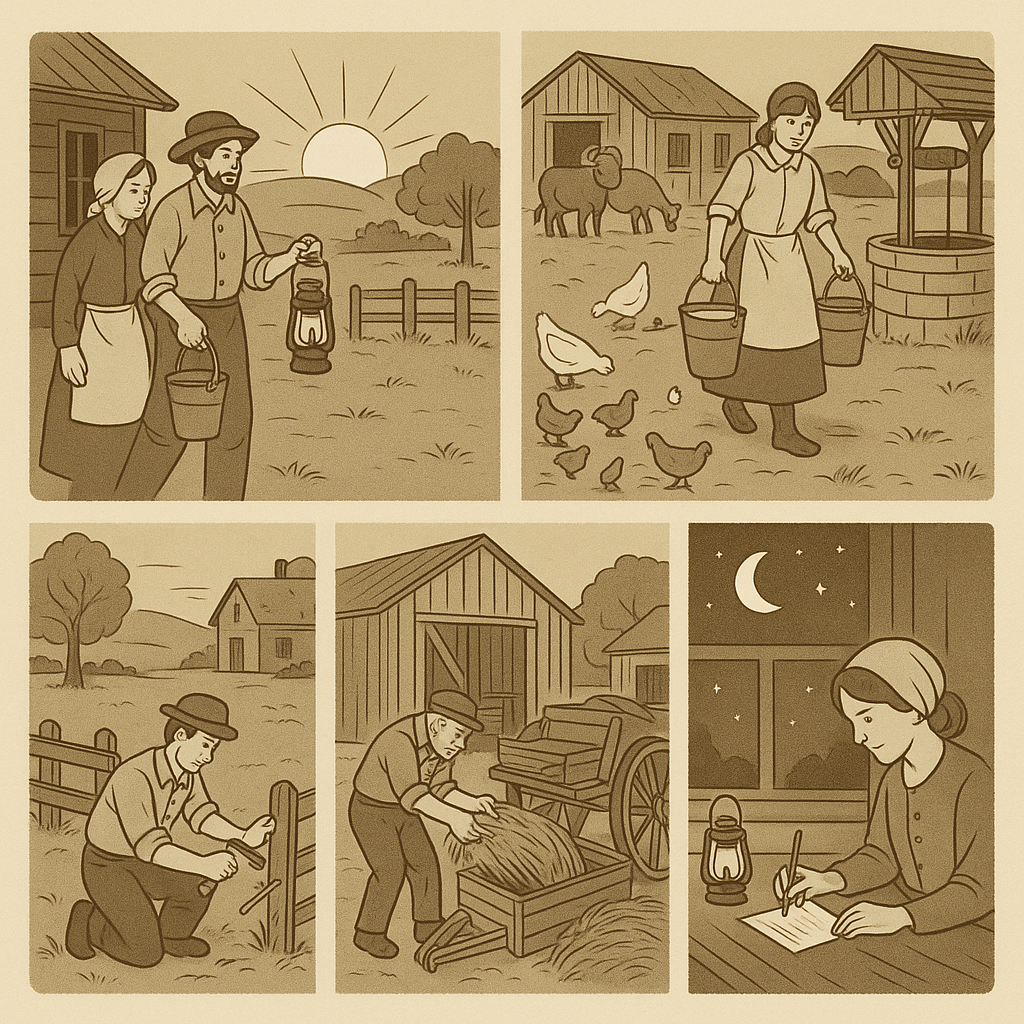
The day usually started before sunrise. The family woke, lit a lantern, and put on boots. They fed the animals and carried water from the well.
Some fields needed work, so the adults walked out with tools. The children often helped with small jobs. Did they play in the morning? Not much; chores came first.
The kitchen was busy at noon. They cooked soup, baked bread, and ate together. They didn’t have much free time, but they found a moment to tell stories.
In the afternoon, someone mended a fence or repaired a cart. Did they use machines? Sometimes, but many jobs were done by hand.
After sunset, the family checked the animals again. The barn wasn’t warm in winter, so they brought extra straw.
Were there visitors on workdays? Rarely. The nights were quiet; the sky showed many stars. Before sleep, they wrote a few lines in a notebook or planned the next day. Life was simple, and the work didn’t stop.
EXTRA ACTIVITY
🧠 THERE IS / THERE ARE — School & Clothing (B1 Level)
Fill in each blank with there is, there are, or is there / are there where appropriate.
- In my locker, ________ a clean T-shirt I keep for P.E. days.
- ________ any spare uniforms in the storage room?
- On the teacher’s desk, ________ a pile of unmarked exams.
- In our classroom, ________ two students wearing the new school hoodie.
- ________ a dress code we have to follow every day?
- Inside my sports bag, ________ no clean socks left after training.
- ________ any difference between the boys’ and girls’ uniforms in your school?
- Behind the gym, ________ some lockers that nobody uses anymore.
- ________ a stain on your blazer — you might want to clean it before the photo!
- In the art room, ________ colourful jackets hanging on the wall like decorations.
- ________ a rule about wearing trainers instead of formal shoes?
- Under my desk, ________ a pair of gloves I forgot last winter.
- ________ many students who refuse to wear the school tie?
- On Fridays, ________ always a relaxed mood because we can wear casual clothes.
- ________ any changing rooms near the sports hall?
- In our class photo, ________ several people wearing the same jumper as me.
- ________ a reason why you’re not wearing your uniform today?
- In the lost-and-found box, ________ at least ten scarves and three jackets.
- ________ usually extra T-shirts available for students who forget theirs?
- After the fashion show, ________ applause from the entire school.
Activity 1:
- They ______ before sunrise. (wake)
- The family ______ water from the well. (carry)
- They ______ soup at noon. (cook)
- They ______ stories after lunch. (tell)
- Someone ______ a fence. (mend)
- They ______ extra straw to the barn. (bring)
- The nights ______ quiet. (be)
- They ______ the next day before sleep. (plan)
Activity 2:
- play / morning / in / the / did / they / ?
- use / machines / they / did / ?
- visitors / there / were / workdays / on / ?
- help / the children / did / with chores / ?
- warm / the barn / was / winter / in / ?
- write / they / did / at night / notes / ?
Grammar Box — Present Perfect vs Past Simple (B1)
Use & Meaning
- Present Perfect = past action/result connected to now; time is unfinished/unspecified.
Farmers have added sensors this year. (Year not finished; result matters now.) - Past Simple = action finished at a finished time; time is given or understood.
Farmers added sensors in 2019.
Time Markers
- Present Perfect: ever, never, already, yet, just, recently, lately, so far, since 2018, for two years, this week/month/year (unfinished)
- Past Simple: yesterday, last week/month/year, in 2019, on Monday, then, when I was a child, two days ago (finished)
Form
- Present Perfect:
have/has + past participle (V3)- Aff: They have installed new pumps.
- Neg: They haven’t installed new pumps yet.
- Q: Have they installed new pumps?
- Past Simple:
V2(regular -ed / irregular)- Aff: They installed new pumps last month.
- Neg: They didn’t install pumps last month.
- Q: Did they install pumps last month?
Contrast Pairs (same idea, different focus)
- Experience vs time:
I have visited many farms. (no date)
I visited a farm in 2018. (finished time) - Unfinished vs finished period:
Prices have risen this year. (year not over)
Prices rose last year. (finished) - Present result vs past story:
The team has repaired the fence, so the field is safe. (result now)
The team repaired the fence yesterday. (past fact)
“Since” and “For” (Present Perfect)
- Since + start point: We have used drip irrigation since 2021.
- For + duration: They have checked water quality for three years.
Common Mistakes to Avoid
- ❌ I have gone to the market yesterday → ✅ I went to the market yesterday.
- ❌ Did you have seen the new tractor? → ✅ Have you seen the new tractor?
- ❌ They haven’t finish the training. → ✅ They haven’t finished the training.
Quick Checks
- Is the time given and finished? → Use Past Simple.
- Is the time not stated / still in progress or is there a present result? → Use Present Perfect.
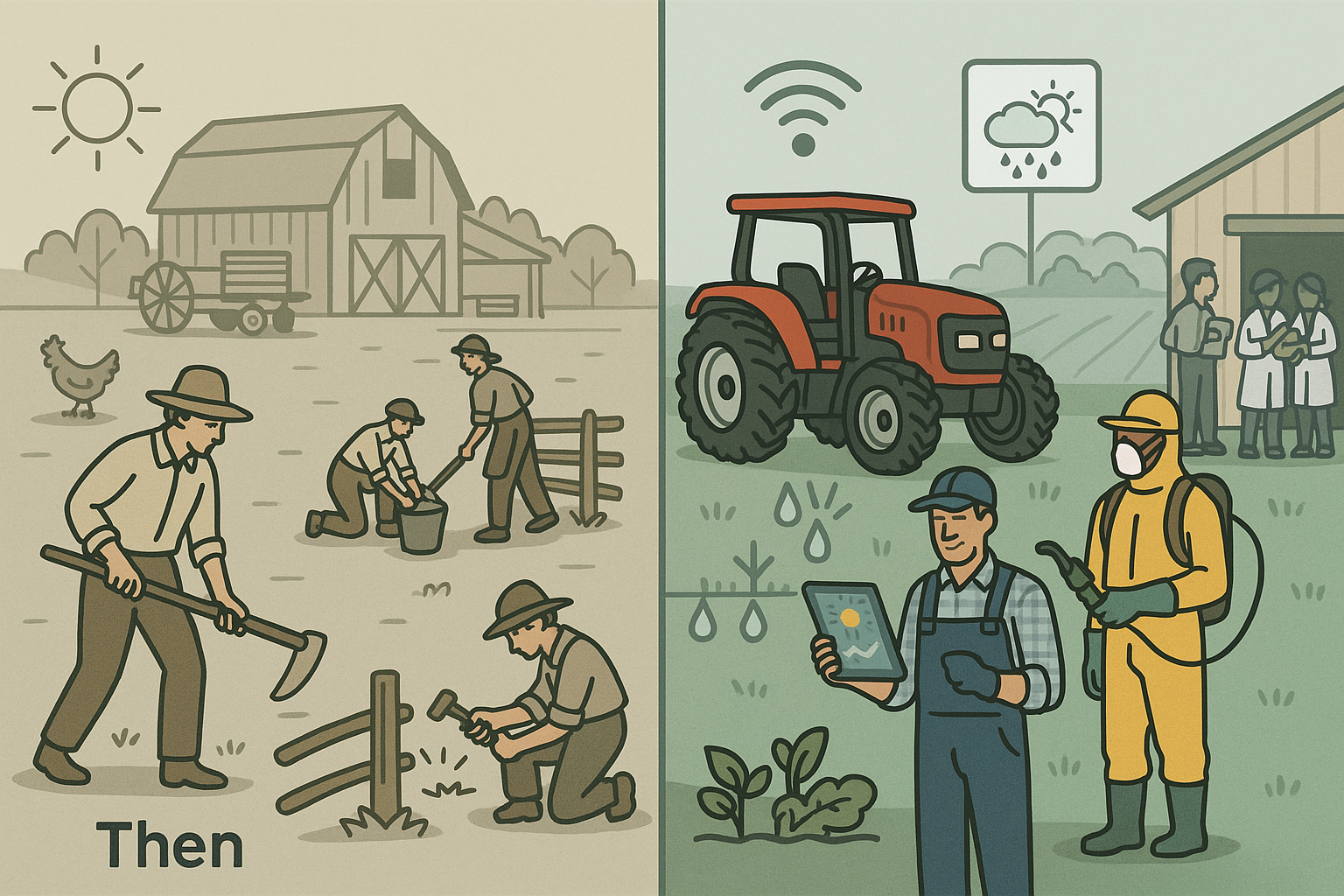
Farming has changed a lot in living memory. In many places, families have added small machines and simple sensors to daily work.
Tractors have become safer, and workers have used protective clothing more often. Since our grandparents’ time, people have replaced some heavy jobs with tools that lift and carry.
Water systems have improved, so fields have received more regular irrigation. Many farmers have connected to the internet and have shared weather data and prices online.
Because of this, they have planned planting more carefully. In the last few years, storage sheds have become cleaner, and teams have checked food quality more often.
Not everything has changed: families have kept early mornings and long days, and they have cared for animals as before.
Sometimes new costs have worried people, but training sessions have helped. Overall, small steps have made work safer and faster, and communities have stayed proud of their fields.
Activity 1 — Present Perfect Gap-fill (8)
Complete with the present perfect and the word in brackets. Use since/for/already/yet/ever/never/just when needed.
- Families ______ small machines to daily work. (add)
- Tractors ______ safer in many places. (become)
- People ______ some heavy jobs with lifting tools since our grandparents’ time. (replace)
- Farmers ______ to the internet and ______ weather data online. (connect, share)
- Teams ______ food quality more often recently. (check)
- New costs ______ some people, but training ______. (worry, help)
- Storage sheds ______ cleaner already. (become)
- ______ you ______ prices online yet? (you/compare)
Activity 2 — Present Perfect: Negatives & Questions (8)
Rewrite as indicated.
- Workers use protective clothing more often. → (Neg.)
- They have improved water systems for years. → (Q: How long…?)
- Families replaced heavy jobs with tools. → (Neg.)
- Teams checked food quality more often. → (Q)
- Training helped. → (Neg.)
- Farmers connected to the internet. → (Q: ever)
- Communities stayed proud. → (Neg.)
- They planned planting more carefully. → (Q: since when)
Activity 3 — Mixed: Present Perfect or Past Simple (6)
Choose the correct tense using the clue.
- Many farms ______ (install) sensors in the last few years.
- We ______ (buy) our first tractor in 2012.
- The team ______ (not finish) the safety training yet.
- Prices ______ (rise) a lot this month.
- We ______ (repair) the shed roof last winter.
- ______ you ______ (ever/use) an online weather map?
 Lingua-Franca