

The Silva family usually spends busy weeks at home. Mum works in a clinic, Dad teaches PE, and the children, Leo and Sara, go to school. Leo catches the bus at seven thirty and Sara cycles with a friend. They don’t eat out on school nights; everyone cooks simple meals and does homework after dinner. Life feels organised but a bit rushed.
This week they are staying in a small flat by the sea. The children aren’t wearing uniforms; they are swimming before breakfast and are taking photos for a blog. Mum is reading a travel book on the balcony, and Dad is trying paddleboarding for the first time. They aren’t checking emails much.
Tomorrow; the island bus leaves at 9.15, so they are meeting a guide at the harbour at ten. On Friday the aquarium opens at nine, but they aren’t going early; they are having a slow morning. In the evenings they walk along the beach and listen to street musicians. Holidays don’t follow their normal timetable, and that’s the best part—everyone is relaxing, laughing, and making new memories together.
Grammar Box — Present Simple vs Present Continuous (B1)
| Tense | Form (statements → negatives) | Main uses | Time markers | Examples (holiday context) |
|---|---|---|---|---|
| Present Simple | I/you/we/they play → don’t play; he/she/it plays → doesn’t play | 1) Habits & routines 2) Facts & states 3) Timetables/schedules (future) | always, usually, often, every…, on Mondays; tomorrow at 7 (timetable) | We usually have dinner at 7. / The ferry leaves at 8 tomorrow. |
| Present Continuous | am/is/are + -ing → am not / isn’t / aren’t + -ing | 1) Actions happening now/around now 2) Temporary situations 3) Fixed arrangements (future) | now, at the moment, this week; tonight, on Saturday (arrangement) | We’re staying in a villa this week. / We’re meeting the guide on Saturday. |
Activities
1) Comprehension (6 items)
- How do Leo and Sara usually get to school? __________
- The family eats out on school nights. True / False
- Where are they staying this week? a) hotel b) flat by the sea c) campsite
- What is Dad trying for the first time? __________
- What time does the island bus leave tomorrow? __________
- On Friday, are they going to the aquarium early? Yes / No (Why? __________)
2) Choose the correct present tense (simple or continuous).
Complete with the verb in brackets. Use negatives where necessary.
- The children usually ___ to school. (go)
- They ___ dinner out on school nights. (eat)
- This week Sara ___ lots of photos. (take)
- Mum ___ on the balcony at the moment. (read)
- The island bus ___ at 9.15 tomorrow. (leave)
- They ___ emails much this week. (check)
- On holidays the family ___ along the beach in the evenings. (walk)
- They ___ a guide at ten tomorrow. (meet)
- Dad ___ paddleboarding for the first time this week. (try)
- The aquarium ___ at nine on Friday. (open)
3) Personal Opinion (short answers; 4 prompts)
- What do you usually do on school days? What are you doing this week that is different?
- Name one arrangement you have for the weekend using present continuous.
- Give a timetable fact using present simple (A train/bus/lesson leaves at…).
- Write two sentences: one positive and one negative about your routine vs holidays.
Grammar Box — Future Plans with be going to (B1)
| Function | Form | Examples (affirmative → negative → question) | Time markers |
|---|---|---|---|
| Personal plan / intention (decided before speaking) | be + going to + base verb | I’m going to visit Gran on Wednesday. → I’m not going to visit her on Tuesday. → Are you going to visit her this week? | tonight, this weekend, next week, on Monday, after school |
| Planned group action | be + going to + V | Our class is going to present on Friday. → It isn’t going to start late. → Is your class going to present first? | timetable words + future phrase |
| Prediction with present evidence | be + going to + V | Look at the clouds—it’s going to rain. | soon, this afternoon |
Short answers: Yes, I am / No, I’m not; Yes, she is / No, she isn’t; Yes, they are / No, they aren’t.
Ava’s “Going-to” Week
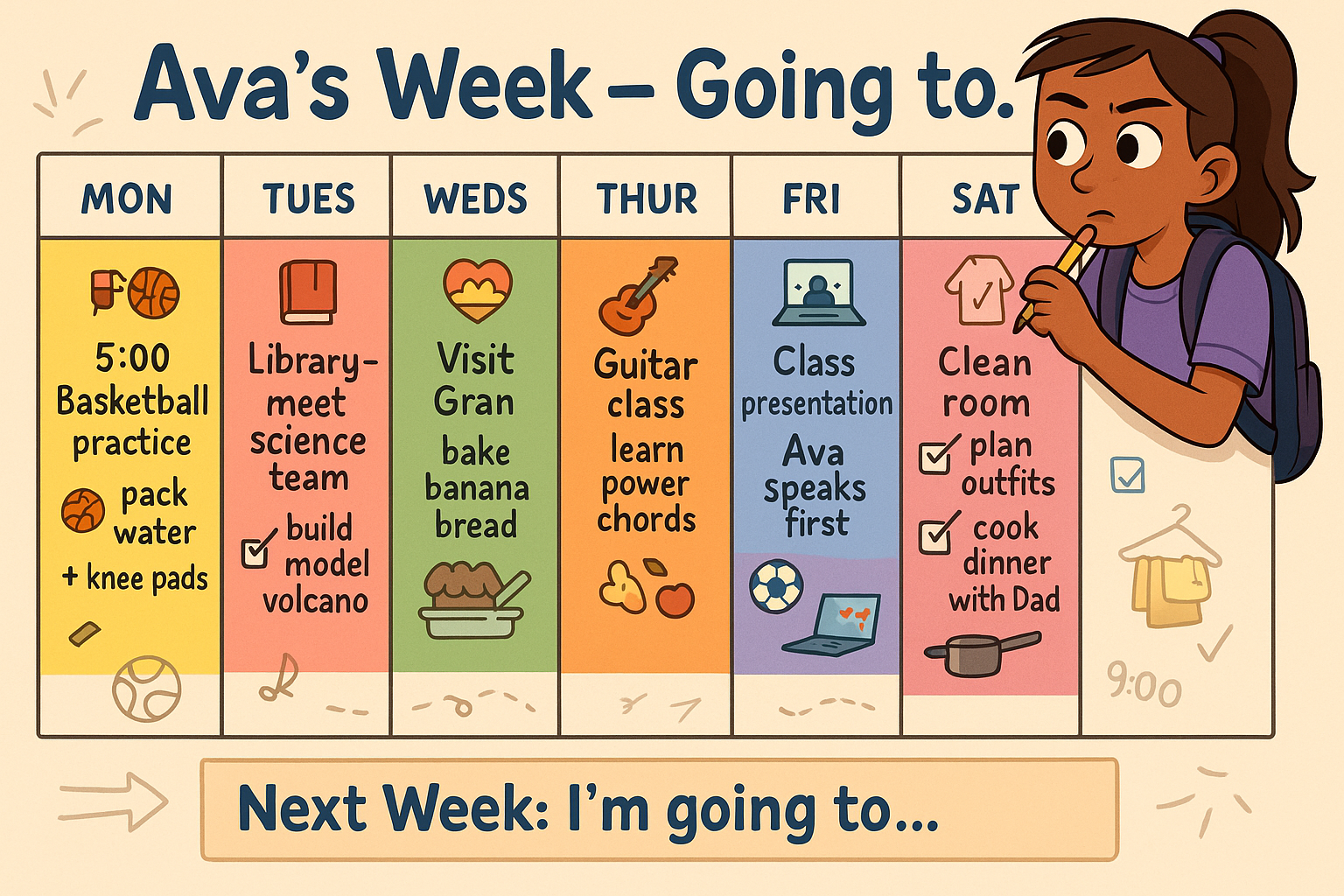
Ava is fifteen, and next week is packed. On Monday after school she’s going to have basketball practice at five, so she’s going to pack water and knee pads. On Tuesday she’s going to meet her science-project team at the library. They’re going to build a model volcano and write the results page.
On Wednesday Ava’s going to visit her gran. They’re going to bake banana bread and chat about school. Thursday evening she’s going to take a guitar class; she’s going to learn power chords for the school show. On Friday her class is going to present the project, and Ava is going to speak first.
Saturday morning the team is going to play a friendly match. The other side looks tired, so Ava thinks they’re going to win. In the afternoon she’s going to video-call her cousin in Canada. On Sunday she’s going to clean her room, plan outfits for the week, and cook dinner with her dad. She isn’t going to stay up late because Monday is going to be busy again.
Activities
1) Comprehension (6 items)
- Where is Ava going to meet her project team on Tuesday? __________
- What is she going to learn in her guitar class?
a) piano scales b) power chords c) violin pieces - Ava is going to visit a family member on Wednesday. Who? __________
- What is Ava going to do first during the class presentation? __________
- When is the friendly match? __________
- On Sunday night, is Ava going to stay up late? Yes / No (Why? __________)
2) Gap-fill — Use be going to (affirmative/negative)
Complete with the correct form.
- Ava ___ (meet) her team at the library on Tuesday.
- They ___ (build) a model volcano.
- She ___ (visit) her gran on Wednesday.
- She ___ (take) a guitar class on Thursday.
- Her class ___ (present) the project on Friday.
- Ava ___ (speak) first.
- The team ___ (play) a friendly match on Saturday.
- She ___ (video-call) her cousin in the afternoon.
- On Sunday Ava ___ (clean) her room.
- She ___ (stay – not) up late on Sunday.
3) Personal Task — Your “Going-to” Week
Write 6–8 sentences about your plans for next week. Include:
- one study plan, one sport or hobby, one family activity, one social plan;
- one negative (something you aren’t going to do);
- one question to ask a partner (e.g., “Are you going to join the club on Thursday?”).
Then compare schedules in pairs and find one time you can meet.
 Lingua-Franca