The Green Commuters Club
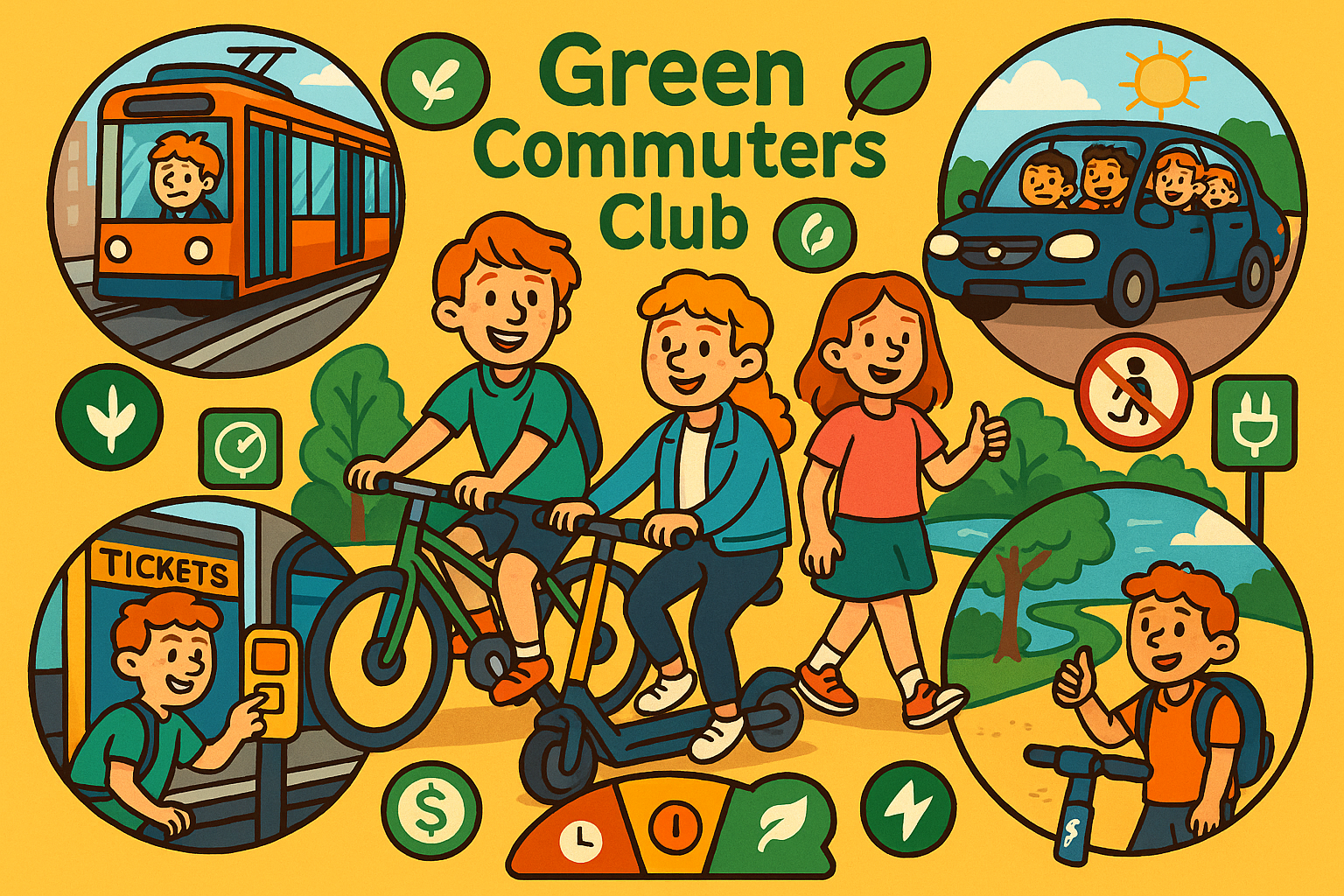
Our school started a “Green Commuters Club” last month. The idea is simple: get to school in smarter, cleaner ways and share tips with others. We keep a chart in the corridor to compare how we travel. It’s not a competition, but everyone enjoys seeing who finds the fastest or the most creative route.
On Mondays, I usually take the tram because it’s cheaper than the bus with my monthly pass. I have to validate my ticket every time, or I’ll get a fine, so I keep my contactless card in an easy pocket. The tram isn’t the fastest option during rush hour, but it’s more reliable than my dad’s car, which often gets stuck near the city centre.
My best friend, Leila, often uses a dockless bike. She says the bike lanes are safer than before, but you must wear a helmet—that’s the rule at home and it’s just good sense. When it rains, Leila sometimes books a car-share with her mum. It’s not the cheapest, yet it produces fewer emissions than three separate cars.
Our classmate Mateo usually rides an e-scooter. He charges it at a public charging point near his building. If the battery is low, he can switch to the metro. He thinks the scooter is the most convenient choice because he can avoid traffic and park next to the school gate. However, he mustn’t ride on the pavement; the signs are clear.
On Fridays, our club tries a “Car-Free Morning”. Teachers often join us and share shortcuts. Last week Ms Lane showed us a quieter street that connects directly to the river path. Walking there took a little longer, but the view was better than any bus window and we all arrived relaxed. We should repeat that route during exam week!
We’re learning that no single option is perfect. Some days the metro is quicker than cycling; other days a scooter is safer than the tram. What matters is planning ahead and respecting the rules. If our club keeps growing, the school might become the greenest place in the district—and that would be a win for everyone.

Activity 1 — Reading Comprehension
- What do students record on the corridor chart?
- Why does the writer keep a contactless card in an easy pocket?
- Which transport does Leila prefer and why?
- What two advantages does Mateo see in using his e-scooter?
- Find two examples from the text where safety rules are mentioned.
- On which day do teachers often join the students?
Activity 2 — Vocabulary: City Travel Collocations
(8 items: 2 Easy • 5 B1 • 1 B1+)
A. Match the halves.
- monthly ________
- rush ________
- bike ________
- contactless ________
- public charging ________
- car-free ________
- traffic ________
- dockless ________
a) card
b) hour
c) pass
d) lane
e) point
f) zone
g) fine
h) bike
B. Circle the word that doesn’t fit the transport set:
- fare – ticket – helmet – pass
Activity 3 — Grammar 1: Comparatives & Superlatives
A. Complete with the correct form.
- The tram is __________ (reliable) than my dad’s car in rush hour.
- Bike lanes are __________ (safe) now than last year.
- Walking gave us the __________ (good) view of the river.
- Car-share isn’t the __________ (cheap) option, but it reduces emissions.
- On rainy days, the metro can be __________ (fast) cycling.
B. Transform the meaning using the prompt.
- The scooter is very convenient. (the most …) → The scooter is __________ choice for Mateo.
- Tram vs car in rush hour: The tram wins. (… than …) → The tram is __________ my dad’s car in rush hour.
- The bus window view was not as good as the river path. (… better than …) → The river path view was __________ the bus window.
Activity 4 — Grammar 2: Obligation & Advice
A. Choose the best option.
- You (must / should / can) validate your ticket every time.
- Students (mustn’t / shouldn’t / don’t have to) ride on the pavement.
- During exams you (must / should / have to) try the quieter route; it helps.
B. Complete with the correct form of must / mustn’t / have to / don’t have to / should / shouldn’t.
- Mateo __________ wear a helmet; it’s safer.
- We __________ pay a fine if we forget to validate—so remember!
- On Car-Free Morning, teachers join us, but we __________ come by bike; walking is okay.
- Visitors __________ read the signs carefully in the city centre.
- You __________ park scooters beside the gate; the sign says “No parking”.
C. Rewrite keeping the meaning. (B1+)
- It’s a good idea to plan ahead. → You __________ plan ahead.
- It isn’t necessary to take the bus every day. → You __________ take the bus every day.
Activity 5 — Use of English: Multiple-Choice Cloze
City Festival Travel Tips
This weekend the streets will be busy, so plan your journey. The metro is usually (1) _________ than driving, and you can save money with a day (2) _________. If you cycle, check your brakes (3) _________ you leave and wear a helmet. You (4) _________ not ride on the pavement; use bike lanes. Buses may be delayed, (5) _________ extra time. If you get lost, ask a steward—they’re (6) _________ to help. Remember to (7) _________ your ticket and keep it with you. Finally, choose the greenest option you can; small changes (8) _________ a big difference.
1 A quicker B quick C quickest D as quick
2 A pass B bill C card D receipt
3 A while B until C before D since
4 A should B must C have D might
5 A take B taking C took D to take
6 A glad B likely C ready D able
7 A validate B borrow C replace D cancel
8 A make B do C put D take
Activity 6 — Use of English: Open Cloze
Going Greener at School
Many students want to travel in a cleaner way, (1) _________ they don’t know where to start. One idea is a “car-free” day each week. You (2) _________ walk or cycle if the distance is safe, or use public transport. If you live far away, try car-sharing (3) _________ a neighbour. You (4) _________ remember basic rules: you mustn’t ride on the pavement and you (5) _________ always stop at crossings. Planning matters: check the weather, (6) _________ you can choose the best route. With small changes, our school could become (7) _________ greenest in the area—and we would all (8) _________ proud of that.
Activity 7 — Listening (Teacher-read script + tasks)
Script (read 2× at natural B1 speed):
“Good morning, students. Here are today’s travel updates. Tram line 2 is open but slower because of maintenance near River Bridge—add ten minutes to your trip. Bus 14 doesn’t stop at Central Square until 10 a.m., so use Bus 9 or the metro if you need that area earlier. Remember, you must validate your ticket before you go down to the platform; inspectors are working today. E-scooters are allowed on School Street after 3 p.m. only; before that time, please park them at the charging point on Hill Road. Finally, for a greener journey, we suggest walking the Park Path. It is longer by five minutes, but it’s safer and much quieter.”
Tasks
A. Note completion (write ONE–THREE words):
- Tram line 2: add __________ to your trip.
- Bus 14: no stop at Central Square until __________.
- Validate your ticket before going to the __________.
- Inspectors are working __________.
- E-scooters allowed on School Street after __________ only.
- Park scooters at the __________ on Hill Road.
- Park Path is __________ but safer and quieter.
B. Multiple choice
8. Which route is suggested for a greener journey?
A) River Bridge
B) Park Path
C) Central Square
9. What should students do earlier than 3 p.m. with scooters?
A) Ride slowly on School Street
B) Park at the charging point
C) Keep scooters at home
10. Why is Tram line 2 slower?
A) New timetable
B) Maintenance
C) Bad weather
Activity 8 — Speaking Tasks
- Photo comparison (B1): Bike lane vs metro platform—compare, then say which is better for rainy days and why.
- Collaborative task (B1): Plan a car-free morning for your class. Agree on rules (must/mustn’t) and advice (should).
- B1+ extension: Argue for the greenest route to school for three different students (far away, close but heavy traffic, carrying a heavy bag).
Activity 9 — Writing
Article (100–120 words): How to get around our town—smart and green
Include:
- one comparative and one superlative,
- one rule (must/mustn’t/have to),
- one piece of advice (should/shouldn’t),
- at least two connectors (because/however/so/although).
Model (≈110 words):
Getting to school can be cheaper than you think.
First, try the tram; it’s the most reliable option during rush hour. You must validate your ticket, but the contactless card makes it quick. If the weather is good, you should cycle because the new bike lanes are safer now.
On rainy days, walking the Park Path takes longer, however, it’s quieter and you arrive calmer. Car-sharing with neighbours is useful too, although you need to plan the time carefully. None of these ideas is perfect every day, so choose the one that fits your morning. Small choices really help our town stay green.
Teacher Check
- Difficulty mix respected (≈25% easy, 50% B1, 25% B1+).
- All questions align with the reading/listening texts.
- Grammar, collocations, and spelling checked; varied lexis included.
 Lingua-Franca